
They confronted hate and lies with truth and love
Seminarians Dennis Trickey and Padrick Mulligan share their story behind this image
By ANDREW HANSEN
Editor
GRANITE CITY — A man is so convinced Catholicism is false, he creates a large sign where on one side it says, “Catholicism is of the devil. It will send you to hell.” On the other side, he lists Catholic teachings he believes are lies. The man then heads to an area close to St. Elizabeth Catholic Church in Granite City where he stands there outside, holding his sign for everyone walking into Mass to see.
This isn’t the first time this man has done this. In fact, he has been doing this for weeks. On this Sunday, he displayed his large sign, but on other Sundays, he used a megaphone to yell at Mass goers saying to them, “Your priest is lying to you! He is giving you the false gospel! Don’t go in there. It is dangerous!”
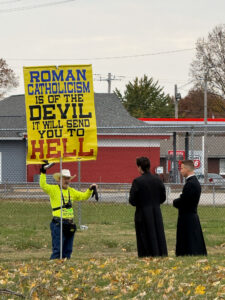 After a few weeks of this this man verbally and non-verbally attacking Catholics, seminarians Dennis Trickey and Padrick Mulligan, who are attending nearby Kenrick-Glennon Seminary in St. Louis, had enough. So, on Nov. 17, 2024, they approached the man for a conversation.
“On this occasion, we had just finished praying with the Men at Prayer group in the school after the 8 a.m. Mass, and we saw him standing there near the entrance to the parking lot, so we decided to walk out there together,” Mulligan said. “So, we started talking to him at about 10 a.m. and continued right up until the 10:30 a.m. Mass.”
While the man was unwilling to share his name, over the next 30 minutes, Mulligan and Trickey spoke to him with patience, kindness, and conviction, challenging the man’s assertions of the Catholic Church, while remaining respectful. They started first by asking the man what he believed.
“He seemed to be very sincere in his concern that we were teaching a ‘false gospel,’ and that we were leading souls to Hell, but as we talked, it became clear that his understanding of our Catholic beliefs were classic misunderstandings that non-Catholic Christians often have,” Mulligan said.
The man was holding a Bible, so the two seminarians then tried to engage with him on a scriptural level. The man’s main issues were the Catholic Church’s teachings about Mary being the mother of God, Purgatory, the real presence of Jesus Christ in the Eucharist, the authority of the pope, and the sacramental role of priests. All of these he claimed were not scriptural and therefore heretical.
“The man quoted various parts of scripture trying to support of his views, but when we would give him some scriptural references of our own, he claimed that we were misinterpreting them. For example, we brought up John chapter 6, the Bread of Life Discourse, to support our belief that the Eucharist is the real presence of Jesus, but he insisted that that passage was meant to be interpreted more figuratively.” (See next page for learn about the Bread of Life Discourse and why Catholics turn to this passage to show that Jesus meant the Eucharist is His Body, Blood, Soul, and Divinity.)
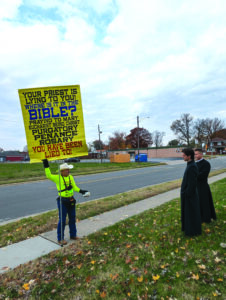 “The intention that I carried with me in the confrontation was to show that I care about him, and that the Catholic Church, no matter how much he hates her, desires for him to enter the fold,” Trickey said.
After some more back and forth conversation, the three of them exchanged some literature pamphlets and then Mulligan and Trickey went off to Mass.
“The man was actually very keen to continue the conversation and tried to continue even as we were walking back toward the church,” Mulligan said. “In the end, we thanked him for chatting and he said, ‘I love you guys, and I'm praying for you.’”
While the two never learned his name, the air of hostility that they encountered at first had thawed somewhat by the end of the conversation.
“I was very much wanting to speak to this man from the first time he came not only because it seemed to be a great opportunity to exercise what I have learned in the seminary in my studies of Scripture and theology, but also, and I would say primarily, because I felt somewhat protective of the faithful whom he was targeting with his signs and yelling,” Mulligan said. “When we did go out to speak to him, I wasn't so concerned about whether we would convince him of anything, although we did manage to teach him something new: He didn't know Catholics believe Hell is real. I personally felt unperturbed by this man's extreme rhetoric, and I wanted lay Catholics going to Mass that day to see us facing him with charity and with our Catholic faith held firmly. I wanted our people to feel inspired to greater confidence and pride in being Catholic.”
“I continue to pray for his conversion,” Trickey said. “I hope that he comes back so that Padrick and I can continue our conversation with him. It would be so cool if by the end of the school year, we were able to bring him off the corner and into the parish center to share a cup of coffee with him and talk about the Catholic Church.”
How to defend the Eucharist when talking to our non-Catholic friends
Why John Chapter 6, the Bread of Life Discourse, proves the Eucharist is Jesus, truly present
Protestant attacks on the Catholic Church often focus on the Eucharist. This demonstrates that opponents of the Church — mainly Evangelicals and Fundamentalists — recognize one of Catholicism’s core doctrines. What’s more, the attacks show that Fundamentalists are not always literalists. This is seen in their interpretation of the key biblical passage, chapter six of John’s Gospel, in which Christ speaks about the sacrament that will be instituted at the Last Supper. This tract examines the last half of that chapter.
John 6:30 begins a colloquy that took place in the synagogue at Capernaum. The Jews asked Jesus what sign He could perform so that they might believe in Him. As a challenge, they noted that “our ancestors ate manna in the desert.” Could Jesus top that? He told them the real bread from heaven comes from the Father. “Give us this bread always,” they said. Jesus replied, “I am the bread of life; whoever comes to me will never hunger, and whoever believes in me will never thirst.” At this point, the Jews understood Him to be speaking metaphorically.
Jesus first repeated what He said, then summarized: “‘I am the living bread which came down from heaven; if anyone eats of this bread, he will live forever; and the bread which I shall give for the life of the world is my flesh.’ The Jews then disputed among themselves, saying, ‘How can this man give us his flesh to eat?’” (John 6:51–52).
His listeners were stupefied because now they understood Jesus literally — and correctly. He again repeated His words, but with even greater emphasis, and introduced the statement about drinking His blood: “Truly, truly, I say to you, unless you eat the flesh of the Son of man and drink his blood, you have no life in you; he who eats my flesh and drinks my blood has eternal life, and I will raise him up at the last day. For my flesh is food indeed, and my blood is drink indeed. He who eats my flesh and drinks my blood abides in me, and I in him” (John 6:53–56).
Notice that Jesus made no attempt to soften what He said, no attempt to correct “misunderstandings,” for there were none. Our Lord’s listeners understood Him perfectly well. They no longer thought He was speaking metaphorically.
In John 6:60 we read: “Many of his disciples, when they heard it, said, ‘This is a hard saying; who can listen to it?’” (It is here, in the rejection of the Eucharist, that Judas fell away; look at John 6:64.) “After this, many of his disciples drew back and no longer went about with him” (John 6:66).
This is the only record we have of any of Christ’s followers forsaking Him for purely doctrinal reasons. If they erred in taking a metaphor in a literal sense, why didn’t He call them back and straighten things out? Both the Jews, who were suspicious of Him, and His disciples, who had accepted everything up to this point, would have remained with Him had He said He was speaking only symbolically.
But He did not correct these protesters. Twelve times He said He was the bread that came down from heaven; four times He said they would have “to eat my flesh and drink my blood.” John 6 was an extended promise of what would be instituted at the Last Supper — and it was a promise that could not be more explicit.