
The dangers of youth sports parents are forgetting (or ignoring)
Full bleachers, empty pews. Play hard, pray less
The odds of high-level athletic success are slim despite parents’ thinking otherwise, all the while the spiritual and family consequences of youth sports are real and often ignored.
By ANDREW HANSEN
Editor
“What is it like having your child in competitive youth sports on the weekends?” When parents are asked this question, responses tend to be more negative than positive: “It’s exhausting.” “It sucks your bank account dry.” “I can’t do anything on weekends.” “It’s always Chik-fil-A and pizza.” “I’m basically just a car service.”
Youth sports, however, are doing more than just draining wallets and making parents tired and potentially burning their children out. Not only are games and practices nearly a full-time job, but tournaments can break families apart many weekends with one parent and sibling going to one city while the other parent and sibling are in another city. Quality family time becomes what is sacrificed. Worse, attending Mass oftentimes gets shelved because a youth, double-header soccer game on a Sunday is more important than worshipping God at Mass and following the commandment of keeping holy the Sabbath.
.02 percent: Those are the odds of going pro
According to NCAA data, the estimated chance of a high school athlete competing in Division I athletics varies by sport but it is generally around 1-3 percent. Overall, about 7 percent of high school athletes go on to compete in college at any NCAA level. Only 2 percent of high school athletes are awarded athletics scholarships to compete in college. Of the student-athletes participating in college sports, 2 percent become professional athletes. Putting it all together, the percentage of a child going pro is approximately 0.023 percent.
Parent’s college/pro expectations for their child are not close to reality
Despite the above statistics, a 2025 study found that 34 percent of parents thought it was somewhat or very likely that their child would become a small-college athlete, 27 percent thought it was likely they would become a college scholarship athlete, and 17 percent thought it was somewhat or very likely they would become a professional or Olympic athlete.
“When parents believe their child thinks of themselves as an athlete, and has a strong athletic identity, that seems to be an on switch for parents to have these very high expectations,” said lead author of the study, Christopher McLeod, associate professor of health and human performance at the University of Florida. The researchers used data on adults in the survey who were parents of children aged 6-17 and living at home.
“We should be concerned about people putting too much focus on their child becoming a high-level elite athlete, given the odds that it is most likely not going to happen for the overwhelming majority,” said Chris Knoester, co-author of the study and professor of sociology at The Ohio State University. “There needs to be a Plan B if the athletic dreams and aspirations don’t work out.”
Spiritual/family impact of youth sports
In a conversation with a father from Springfield, whose children — both under the age of 11 —participate in youth sports that take the family across the Midwest nearly every summer weekend, the question of attending Mass while traveling was raised. He said that they, “Didn’t have time for it.” More troubling, the father acknowledged that he understood skipping Mass to be a serious sin. He was encouraged to attend Mass while traveling, including the opportunity to experience the Catholic faith in different cities and parishes. While he appeared to agree in principle, recognizing that prioritizing Mass over a child’s baseball game was more important — his shrug of the shoulders in the end of the conversation suggested no intention to change. The bottom line was his child’s baseball game was the higher priority.
Several years ago, when the Diocese of Springfield in Illinois announced that confirmations and first holy Communion for third-graders would take place at the Cathedral of the Immaculate Conception in Springfield and not the home parish of the children, the diocese received complaints about this: “The Cathedral is too far away.” “It will be a hassle to get my family to the Cathedral.” “Something this important should be at my home parish.”
Soon after this announcement, one of the Catholic schools in the diocese had a baseball game in Springfield on Saturday. The game was more than an hour drive for families of this school. Yet at that game were some of the very parents who complained about these sacraments moving to the Cathedral. Did this same group of parents complain the baseball game was too far away? No. Did they complain that it was a hassle to bring their family to the baseball game? No. Did they complain this baseball game should have been in their home city and not Springfield? No.
“There are of course many positives of youth playing sports as it builds character, social skills, teamwork, and exercise. It can also be great for parents as it allows them to socialize, build friendships, and see their children playing a game they enjoy,” said Bishop Thomas John Paprocki, who has run dozens of marathons and still plays hockey today. “The problem is when parents and their children make sports the priority, and this is what happens: they pray less, quality family time is sacrificed, and they stop going to Mass. Statistics show a child has a .02 percent of becoming a professional athlete. But we all have a 100 percent chance of being judged by God. I am not saying children shouldn’t chase a dream or play youth sports, but if the family is sacrificing their spiritual life and proper family time, then their priorities are flipped.”
Bishop Paprocki has seen this issue firsthand, not only in seeing fewer families in the church pews but in talking with people when he visits Catholic parishes. He is the author of Holy Goals for Body and Soul: Eight Steps to Connect Sports with God and Faith links lessons from the world of sports and fitness and Running for a Higher Purpose: 8 Steps to Spiritual and Physical Fitness.
“There is a fine line in showing support for your children and their sports endeavors versus putting them on a pedestal with all these weekends and dollars spent revolving around them — which is not healthy for them or the family dynamic,” Bishop Paprocki said. “I cannot stress this enough to parents: if youth sports are causing you to miss Mass and quality family time, then you are indirectly telling your children their game is more important than worshipping God, receiving Jesus in the Eucharist, and growing together as a family. That is a recipe for disaster.”
Pope St. John Paul II agreed. Known for his love of sports, especially skiing, during his address on the Occasion of the Athletics World Championships in 1987, he said, “If sport is reduced to the cult of the human body, forgetting the primacy of the spirit, or if it were to hinder your moral and intellectual development, or result in your serving less than noble aims, then it would lose its true significance and, in the long run, it would become even harmful to your healthy and full growth as human persons. You aretrue athleteswhen you prepare yourselves not only by training your bodies but also by constantly engaging the spiritual dimensions of your person for a harmonious development of all your human talents.”
Former professional soccer star turned priest has advice
Photo courtesy of Father Hilgenbrinck
Parents can feel pressure that their child will miss out or not grow as an athlete if practice or a game or a tournament is skipped. However, Father Chase Hilgenbrinck of the Diocese of Peoria, is proof families can prioritize faith over sports, and the child can still become a great athlete. Before he became a priest, Father Hilgenbrinck was a soccer star in South America for several years and then played in America’s Major League Soccer (MLS).
Growing up and playing competitive youth soccer, Father Hilgenbrinck, who grew up in Bloomington, says he remembers on those travel weekends, all the families would get together on Saturday nights for a meal and “that was more fun than even the games.” His family, however, didn’t always go to those dinners, instead finding a Mass that Saturday night and worshipping God together as a family.
“Sometimes, we would play into Saturday evening and we were not able to go to Mass,” Father Hilgenbrinck said. “So, we would wake up at 6 a.m.! I am an athlete … I have to get sleep! We would wake up at 6 a.m. for a 7 a.m. Mass, and I would have an 8 a.m. game. So, we would show up to those games late but, this was the Eucharistic priority.”
How to easily find Mass times while traveling and key reminder for parents
One of the best resources for any traveler is masstimes.org. Just punch in your zip code or city, click which day you want to attend Mass, and then churches are listed by Mass times and miles away, instantly. Pro tip: After you find a Mass time and location that works for you, go to that parish website to make sure the time is accurate.
“All these cities that parents are traveling to have plenty of Mass times and locations, and with a resource like masstimes.org right at their fingertips, there is no excuse of ‘I couldn’t find a Mass,’” Bishop Paprocki said. “As Scripture says, ‘What does it profit a man if he gains the whole world but loses his soul?’” (Mark 8:36)
Father Mark Tracy, pastor of Christ the King Parish in Springfield, played several sports growing up. With two brothers and a sister, sports was an everyday activity in their family. What he remembers, however, differs from today, and in not a good way.
“I remember going to Mass with my uniform on and seeing other children my age with their uniform,” Father Tracy said. “It was encouraging to see my peers recognize that God comes before sports. Today, instead of seeing uniforms, you just hardly see these sports families at all. Catholic teaching stresses that parents have the primary responsibility of raising their children in the faith. So, this may sound harsh, but it’s true: on judgement day, when God asks these parents, ‘Why did you not bring your children to Mass? Why did you prioritize sports over Me?’ These parents won’t have an answer. So, it is best to change your ways now, and a reminder, if you have skipped Mass without a valid reason, you must confess that sin in the sacrament of confession before you can receive the Eucharist.”
Athletic director and Super Bowl winning coach on how travel leagues and specialization can harm children
There are many positives of youth sports. First, the physical exercise it provides. It can also help social development. According to the National Institute of Health, both male and female athletes were more likely to eat healthier and less likely to engage in smoking and illicit drug-taking. A reduction in suicidal thoughts and tendencies has also been demonstrated for both teenage boys and girls who engage in sports.
However, beyond the spiritual dangers of putting sports above faith, there are some negatives parents need to know.
Studies show that children specializing in one sport year-round before puberty are more than twice as likely to suffer serious overuse injuries versus multi-sport peers. Injuries are also something to be careful with because children are still growing. The National Institute of Health reports, “During periods of increased growth velocity and closure of the growth plates in adolescence, young athletes are vulnerable to a variety of traumatic and overuse injuries.”
Sports satisfaction surveys reveal that “having fun” is the main reason that most children like to participate in sports, however, parents’ perception of why their children like to play sports is to “win.” The Institute for the Study of Youth Sports looked at the importance of winning from the child’s perspective and found that “… it varied with gender and age, but for the majority of younger children, fairness, participation, and development of skills ranked above winning. It appears that this disconnect amongst young athletes and adults may contribute to stress and unhappiness on the part of the child.”
Parents also need to be mindful of other siblings who may start to believe their brother or sister is more important than them because family schedules and dollars revolve around their brother’s or sister’s sports schedule.
David King, a former university athletic director who wrote the book, Overplayed, said this in the magazine, America:
“I’ve become increasingly concerned about the toll that current youth sports culture is taking on children, young people, and families. Families’ dollars and time are stretched and stressed. Children are suffering overuse injuries and burning out at younger and younger ages. They’re being asked to perform beyond appropriate developmental stages. They’re failing to develop some of the intrinsic values that adults assume sports will teach them. Parents are damaging their relationships with their kids and with each other. And far too often, as we struggle to navigate this new terrain, we’re driven not by love but by fear.”
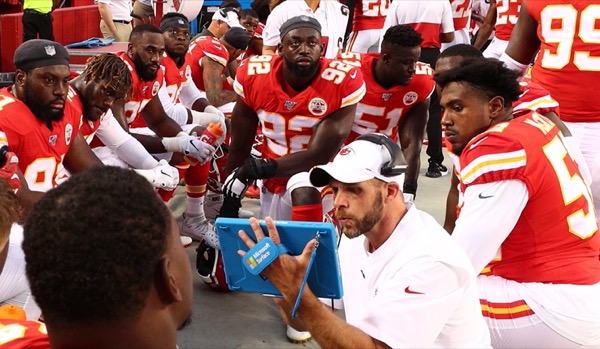
Brendan Daly, a graduate of Christ the King School and Sacred Heart-Griffin High School in Springfield, is a six-time Super Bowl winning coach, first with the New England Patriots and now with the Kansas City Chiefs. Appearing on Dive Deep, the podcast of the Diocese of Springfield in Illinois, he was asked, “What is your advice for young athletes today?”
“I would say, don’t turn it into a job. Limit the specialization,” Daly said. “Play multiple sports and don’t allow adults to screw it up for you. I think our society has turned to the constant pressure to succeed, gain an advantage, and year-round specialization and club sports. I honestly would like to see kids play everything and enjoy it. Just go to the park and play.”
Being an NFL coach, Daly’s weekends are all business during the season. There is game preparation all day on Saturday, and then most of the time, game days are Sunday. Despite him having an NFL weekend of work, he still gets to Mass.
“One of the things I have appreciated is, and it has been the case in every NFL team I have been with, whenever we are playing, typically, the evening before the game, there is both a chapel and a Mass that is available to the players, coaches, and support staff,” Daly said. “I have always been a regular participant at those. It has been a fun experience in terms of getting to know a number of priests in the various teams and cities I have worked in, but then also as you travel on the road and you are in a hotel somewhere, it’s usually a priest from one of the parishes there that you get to know. So, I have had the privilege of getting to know a lot of different priests and going to a lot of different Masses. I have enjoyed that experience.”
What should sports in the family look like then?
Taking all this information into consideration, what should competitive youth sports look like for Catholics?
Father Joshua Whitfield, a married priest and father of five children in Texas, and who wrote the book, Why Sunday Matters: The Lord’s Day in Contemporary Christian Life, answers it this way:
“Youth sports should serve the human person, helping each child to become someone who knows, loves, and worships God because that’s what it means to be human, to flourish, and find holiness. Play and worship are those gifts of creation that not only offer the pleasantness of rest, but also a foretaste of heavenly rest. Play and worship mystically mirror each other. That’s why the Church doesn’t let families off the hook for Sunday Mass. The Church does not forbid games on Sunday, but the Church does insist upon Sunday Mass. It should all fit together: youth sports, play, and worship. Conflict is only a matter of illusion and sin.”b