
Sister Doris cares for the very young, walks with God among the people
By DIANE SCHLINDWEIN
Managing Editor
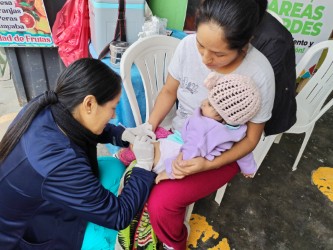
CENTRAL ANDES, PERU — Not all of the Dominican Sisters of Springfield live in central Illinois; in fact, right now seven of the sisters live and work in Peru. Sister Doris Consuelo Terrel Jiménez, OP, who is a nurse, is one of those sisters. “I am from the central Andes, Peru, in the town of La Oroya,” she said. “I have been with the Springfield Illinois Dominicans for 21 years from the time I entered the congregation.”
Sister Doris primarily works with very young children. She remembers that she felt a calling to nursing as early as her teens. “My vocation as a nurse was born during my high school studies. My school was a technical institute which had nursing as one of the offered courses,” she said. “It was during this time that I learned basic nursing and did my practice at the Parish Center. That awakened in me a desire to help the most vulnerable people with their health needs.”
Sister Doris was a young woman when she became interested in religious life and was introduced to the Dominican Sisters. “What attracted me to religious life were encounters with God at different times in my life, listening to God, getting to know and follow Him,” she said. “The parish in La Oroya was run by a shared mission of the Springfield Dominicans and priests from the Congregation of the Precious Blood Fathers. I was impressed by their service and works and talked to them about it.”
The Precious Blood Fathers introduced her to the Dominican Sisters. “The sisters invited me to share in some meals, to pray with them, and to accompany them in their ministry,” she said. “What attracted me to be a Dominican was the way the sisters reflected Jesus in their lives and the passion they showed working in different ministries.
“With the Dominican Sisters I began a process of discernment regarding formal studies. At first, I was scared about how long it would take after being out of school for many years, and I thought further studies were not necessary,” she said. “Our sisters in leadership supported me a lot and were open, so after a search I decided on nursing studies offered by the Escuela Padre Luis Tezza in Lima — the Congregation of the Sisters of St. Camila. It was a course of five years with practicums in state hospitals and a year of SERUM, which is rural service in marginalized areas, with no salary.”
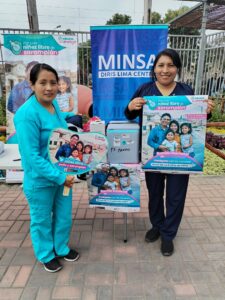
These days, Sister Doris begins her day early, with breakfast at 6 a.m. “Then I am off to work,” she said. As a traveling nurse she specializes in treating children under 5 years old, with a focus on their growth and development. “I also administer the complete series of vaccinations, as I work for the Ministry of Health in the Central Lima office belonging to the Central Government.”
Each week Sister Doris is assigned to several health centers. “I coordinate with the nurse in charge for the necessary supplies and work schedule,” she said. “I go from house to house, finding my patients and then programming the follow-up that is necessary. I also coordinate with educational institutions to program health interventions.”
Sister Doris usually works with a health technician as a team of two, but other times more people are involved. “On other opportunities we form a diverse team of professionals with a doctor, a psychologist, a dentist, a nutritionist, and the nurse to offer an integral approach to health,” she said. “With a team like this we set up in a park or a school to offer services to the public.”
At the end of each day, Sister Doris goes home to pray with the other sisters, talk about their experiences that day, and take care of other community needs. Sister Doris lives with two other sisters. “Our central house, Casa Maria, is in Lima, in the district of Pueblo Libre,” Sister Doris said. “In my local community we are three sisters — hermanas. We don’t have a common ministry; each of us has a different one. Our community spaces are very important.”
Sister Doris says she thrives on serving in public health and sharing people’s lives. “I like public health,” she said. “It is sharing life with ordinary people, listening to them, learning and walking with them day by day. They often tell us that we are their work partners.”
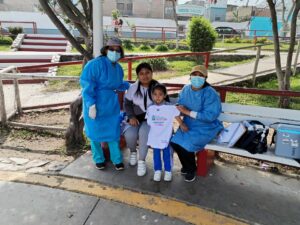
Prayer is a part of that partnership. “The houses we visit always have people who bless us and pray for our work,” she said. “They tell us about their difficulties, and we offer prayers. They are a people who thirst for God and share in our ecumenical faith in need of a sacred ministry present in our lives.”
And always, no matter where she goes, Sister Doris says God remains with her. “Life on the street is hard. Many make a living by what they can sell that day; crime and delinquency is feared by many. There is a lack of trust, hunger, not much opportunity for work and a dignified life,” she said. “Many times, I feel powerless and can’t do anything about it. The reality now is a lack of safety, rising crime, and murders daily. In the midst of my fears, I want to do this work, go out of my comfort zone, and walk with God who is present among the people.”
This is the third of several CATHOLIC TIMES articles that highlight religious sisters who work in the areas of science, technology, engineering, and mathematics.