
Pope Francis launches Jubilee 2025 – How you can receive an indulgence in our diocese in 2025
Credit: Vatican Media
Pope Francis launches Jubilee 2025, ‘Pilgrims of Hope,’ with opening of Holy Door
How you can receive an indulgence in our diocese this year
By Hannah Brockhaus of Catholic News Agency and Andrew Hansen, EDITOR
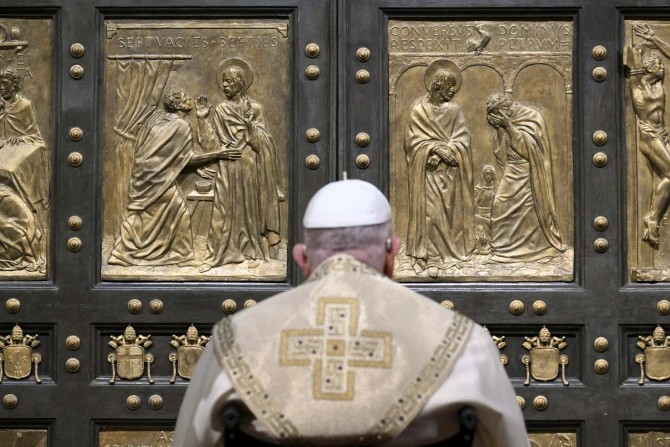
Pope Francis opened the Holy Door of St. Peter’s Basilica before Mass on Christmas Eve, officially launching the Jubilee Year 2025. The theme for this Jubilee Year is “Pilgrims of Hope.”
The rite to open the Holy Door – sealed since the extraordinary Jubilee of Mercy in 2016 – included the proclamation of a passage from the Gospel of John in which Jesus says: “I am the door. If anyone enters by me, he will be saved and will go in and out and find pasture. The thief comes only to steal and kill and destroy. I came that they may have life and have it abundantly.”
The first ordinary jubilee since the Great Jubilee of 2000 is on the theme of hope, a virtue that “Does not deceive or disappoint because it is grounded in the certainty that nothing and no one may ever separate us from God’s love,” Pope Francis said. “For everyone, may the jubilee be a moment of genuine, personal encounter with the Lord Jesus, the ‘door’ of our salvation, whom the Church is charged to proclaim always, everywhere, and to all as ‘our hope.'”
What is a jubilee year?
A Jubilee Year is a significant moment in the life of the Church in which she celebrates the year of messianic favor inaugurated by Christ through his Incarnation and Paschal Mystery. Proclaimed every 25 years since the thirteenth century, the celebration of jubilee years typically includes pilgrimages, processions, celebrations of Mass, and an invitation to the Sacrament of Reconciliation (Confession). These liturgical celebrations are opportunities to receive the Lord’s mercy, especially through the practice of the Jubilee indulgence and lead to the performance of works of mercy.
Some of the biggest events of the Jubilee of Hope in the universal Church will be the canonizations of Blessed Carlo Acutis, during the Jubilee of Teenagers on April 27, and Blessed Pier Giorgio Frassati, during the Jubilee of Young People on Aug. 3, and the Jubilee of Families, Children, Grandparents, and the Elderly on the weekend of May 30-June 1.
Bishop Paprocki opens Jubilee Year in our diocese
Bishop Thomas John Paprocki opened the Jubilee Year for our diocese at the Mass for the Feast of the Holy Family on Dec. 29, 2024, at the Cathedral of the Immaculate Conception in Springfield. Mass began that morning with a gathering in the church atrium, and then a short procession outside and through the front door of the Cathedral, “In a sense making a symbolic pilgrimage, serving to symbolize the journey of hope that, illumined by the word of God, unites all the faithful,” Bishop Paprocki said.
Receive an indulgence in our diocese during Jubilee Year
Before we discuss how you can receive an indulgence during the Jubilee Year in our diocese, it’s important to first understand what an indulgence is and why it is such a treasure of our faith you should take advantage of.
Many misconceptions remain regarding indulgences, but the Church has never done away with them. Put simply, an indulgence is a gift and grace that remits the temporal punishment due to a sin, which has already been forgiven but not rectified. The Church grants indulgences for specific pious actions (certain prayers and devotions, pilgrimages, carrying out the works of mercy, reading the Scriptures, etc.) to encourage such devout practices as aids to growth in holiness.
“We may think that having our sins forgiven when we go to sacramental confession means that there is no more punishment for those sins,” Bishop Paprocki said. “But, Pope Francis points out that, ‘as we know from personal experience, every sin ‘leaves its mark.’ Sin has consequences, not only outwardly in the effects of the wrong we do, but also inwardly, inasmuch as ‘every sin, even venial, entails an unhealthy attachment to creatures, which must be purified either here on earth, or after death, in the state called Purgatory.’ In our humanity, weak and attracted by evil, certain residual effects of sin remain. These are removed by the indulgence, always by the grace of Christ.'”
To further illustrate an indulgence, consider this example: the difference between forgiveness of the guilt and paying the penalty can be seen clearly in the sin of stealing. When a person goes to sacramental confession and is absolved of the sin of stealing, there is still an obligation in justice to make restitution, that is, to pay back or restore what was stolen. If the rightful owner also discharges the debt, in a sense that is an indulgence, since the rightful owner is being indulgent in pardoning the debt as well as the guilt.
How do you receive full remission for your sins with the Jubilee Year indulgence in our diocese?
All the faithful, who are truly repentant and free from any affection for sin, who are moved by a spirit of charity and who, during the Holy Year, are purified through the Sacrament of Penance (Confession) and refreshed by holy Communion, and pray for the intentions of the Pope, will be able to obtain from the treasury of the Church a plenary (or full) indulgence, with remission and forgiveness of all their sins, which can be applied [for] the souls in Purgatory, if they undertake a pious pilgrimage to the Cathedral of the Immaculate Conception in Springfield where they devoutly participate in holy Mass, pray the Stations of the Cross, pray the Rosary, or participate in a penitential celebration, which ends with the individual confession of the penitent.
So, for example, one could go to confession at their local parish and then the next day, go to Mass at the Cathedral where they also pray for the intentions of the Pope (praying a Hail Mary and Our Father for the pope’s intentions is suggested). Another example, if one went to the Cathedral and prayed the Rosary, one would have to go to Confession, receive holy Communion, and pray for the intentions of the Pope (this can be at a local parish). These acts “may be carried out several days preceding or following the performance of the prescribed works. But, it is more fitting that Communion and the prayer for the pope’s intentions take place on the day the work is performed” (Handbook of Indulgences, Norms for Indulgences, 23.3).
What if you cannot make a visit to the Cathedral? Bishop Paprocki explains:
“The faithful who are truly repentant of sin but who cannot participate in the various solemn celebrations, pilgrimages, and pious visits for serious reasons, especially cloistered nuns and monks, but also the elderly, the sick, prisoners, and those who, through their work in hospitals or other care facilities, provide continuous service to the sick, can obtain the Jubilee Indulgence, under the same conditions if, united in spirit with the faithful taking part in person, they recite the Our Father, the Profession of Faith in any approved form, and other prayers in conformity with the objectives of the Holy Year, in their homes or wherever they are confined (e.g. in the chapel of the monastery, hospital, nursing home, prison…) offering up their sufferings or the hardships of their lives.”