
Incorrupt body? Missouri religious community says they knew they ‘were living with a saint’
By ANDREW HANSEN
Editor
The following story appeared in the documentary, God is Alive, Part 2, produced by the Diocese of Springfield in Illinois and which premiered earlier this year.
It’s a quiet afternoon on the quaint grounds of the religious community, the Benedictines of Mary, Queen of Apostles in rural Missouri, just under an hour drive north of Kansas City. But in the spring of 2023, it was anything but quiet as thousands of pilgrims and TV crews descended on the property garnering the attention of Catholics and non-Catholics, in awe of what happened. Even the sisters themselves were overcome with joy.
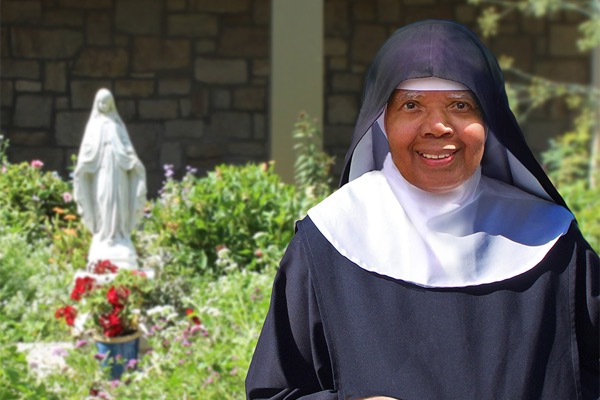
“The sisters were jumping up and down, literally, jumping up and down in the field,” said Sister Scholastica Radel, OSB. “Some were saying, ‘I knew it. I knew it. I knew it would be this way. I knew we were living with a saint.’”
Sister Scholastica is referring to what happened to her community’s foundress, Sister Wilhelmina Lancaster, OSB, who died in 2019. On that spring day in 2023, Sister Wilhelmina’s remains were being moved from the cemetery grounds so she could be reinterred in the newly constructed St. Joseph’s Shrine at the property. When they uncovered her coffin, the sisters discovered a large crack in it.
“Myself and Mother Abbess went to see what was in the crack because we said, ‘We have to see what is in there.’ So, she took a flashlight and shown it into the crack and screamed.”
Sister Wilhelmina’s body, despite being buried for four years, was astonishingly intact. Her face and features easily recognizable, her beloved habit was “immaculate” they said and there was with no foul smell. The thought her being incorrupt — a term used to describe when a deceased body either fully or partially does not decompose — was immediate. The sisters said it looked as if Sister Wilhelmina was buried that day.
“The coffin lining, which was only two inches from her remains in some places, was gone. Everything was gone. The wood on the sides was rotting. Anything touching her, however, was completely intact. Anything that wasn’t touching her was gone,” Sister Scholastica said.
What do experts say about all this? First, it’s important to know Sister Wilhelmina’s body was not embalmed and did not receive any other treatments prior to her burial. She was buried in an unsealed wooden casket and was not placed into any other burial container.
In August 2024, the results of a medical examination of her body confirmed that her body lacked “any detected features of decomposition.” The fact that only bones should have been present, the study, conducted by medical experts and commissioned by the Bishop of Kansas City, Missouri, found, “The condition of her body is highly atypical for the interval of nearly four years since her death, especially given the environmental conditions and the findings in associated objects.”
They also confirmed the sister’s habit and clothing “showed no features of breakdown.”
Barry Lease, president and CEO of the Pittsburgh Institute of Mortuary Science is just as dumbfounded, saying, “If you’re telling me that this woman went into the ground unembalmed in a wooden box with no outer container in the ground and it was not sub-zero up in Alaska, I’m telling you, I’m going to start a devotion to this sister, because something special is going on there.”
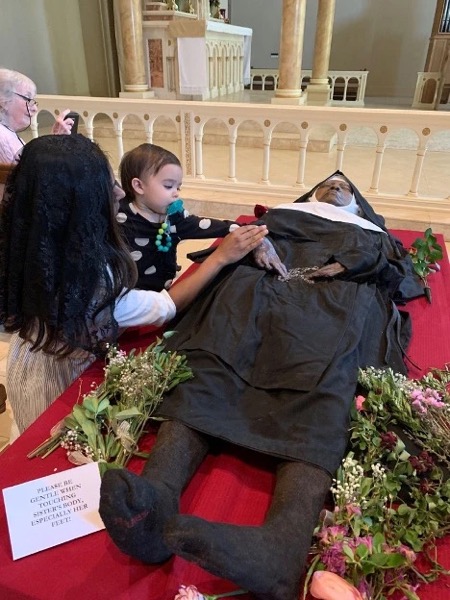
What does Sister Scholastica think God is trying to tell the Catholic world, even the secular world about this story?
“There is life beyond the grave. There is a place where we are to be going, and we will be glorified to and share in Christ’s mystical Body in Heaven.”
There are many examples of saints who are considered incorrupt to Catholic believers, although incorruptibility is not considered to be an indication of sainthood. That said, this religious community says that in her 95 years of life, Sister Wilhelmina was known for the saintly way she lived her life. Born in St. Louis, she entered the Oblate Sisters of Providence shortly after graduating from high school. She then founded the Benedictines of Mary, Queen of Apostles at 70 years old. The order took on a contemplative and Marian charism, with an emphasis on praying for priests. Sister Scholastica lived with Sister Wilhelmina for 19 years. She described her as pious and selfless. She had a love for families, children, and living joyfully. She loved to tell jokes, she loved to dance, and sing.
“She debunked some of the ideas I had of holiness,” Sister Scholastica said. “I think we think of holiness as something beyond our reach, something extraordinary, something impossible. She lived like a saint in that she lived in the presence of God and that didn’t mean she always had her hands folded. So, there were elements of humanity still present. It wasn’t like she was this super woman. But everything was directed toward God.”
Sister Scholastica says amongst the thousands of people who have visited their community, many have reported healings, including cases of cancers being reversed. While all those healings and that Sister Wilhelmina’s incorrupt body is profound, the message of this story has nothing to do with any of that.
“Here is life and you have to make most of that, and if you fail at drawing close to God, then you fail at life altogether because that is really the whole purpose in life is to draw close to our Lord,” Sister Scholastica said. “It’s about holiness and to meet Him face to face and hear Him say, ‘Well done, good and faithful servant.’”
Watch Sister Wilhelmina’s story in the documentary, God is Alive Part 2, here: