
A history of helping
Franciscan Brothers of the Holy Cross at home in see city for nearly a century
By DIANE SCHLINDWEIN
Managing Editor
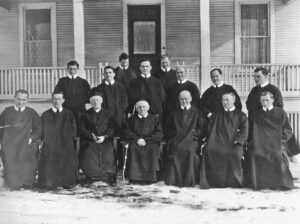
Living a simple life on the far northeast side of Springfield are a group of religious men who look to the example of St. Francis of Assisi as they follow Jesus each day. They are the Franciscan Brothers of the Holy Cross.
The history of these Franciscan Brothers dates back to the year 1862 when a man named Brother James Wirth (born Peter) founded the order in the small village of Hausen, in the western forest area of Germany. He dedicated the brothers to caring for young economically disadvantaged men and training them in various trades. Brother James lived his mission, and died in March 1871, after contracting smallpox from patients he was attending. He was just 40 years old.
It was sixty-two years later when the brothers came to the United States, initially establishing a school for boys in Louisianna, as well as becoming part of the seminary staff at Gretna, La. However, it was on a cold day in January 1928, when 10 of the brothers arrived in Springfield and took over a farm and dairy that was operated by the Hospital Sisters of St. Francis. Most of the original brothers were tradesmen or farmers and soon they were well adjusted to their life in Illinois, and by 1930 were ready to open St. James Trade School.
Brother John Francis Tyrrell, FFSC, who is the current superior of the community, notes that Bishop James A. Griffin asked that the first trade students be boys from the Catholic orphanage in Alton. They were provided schooling, meals, clothing and shelter at the school. The young men had a number of good career choices — they could learn to be a mechanic, baker, bricklayer/mason, carpenter, electrician, machinist, meat processor/butcher, painter, shoemaker, tailor, or welder.
“So those first boys came here and learned trades,” Brother John Francis said. “The trade school never turned anyone away, even if they could not afford to pay for their schooling.” One of the first projects of the trade school was building a monastery for the brothers. The brothers and the young men used materials salvaged from two old houses that were torn down to make room for a playground for Cathedral School.
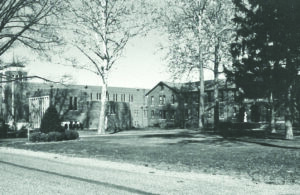
As time went on, boys from Springfield and the surrounding towns came to the trade school, with many of them staying there as boarders. By the 1940s a four-year high school course accredited by the State of Illinois was offered along with the trade programs. From 1930 until 1963, St. James boarded students, and from 1963 until 1972 it was solely a day school. Religion was taught by Viatorian priests, who also taught at Cathedral Boys High School (later Griffin High School) or the Franciscans of the Sacred Heart Province, who were frequently chaplains to the brothers.
The school never had more than 80 students, allowing for more individual attention, and their athletic teams were known as the Tradesmen. Although the largest graduating class was 29 students in 1969, the school closed in 1972 because of increasing running costs and the loss of contracts to supply milk, bread, and meat to local institutions.
After St. James Trade School closed, the brothers prepared for a new mission. They began to receive specialized training in direct care of those with developmental disabilities. In 1975 they built a new building and opened Brother James Court, a home for developmentally disabled men. Early on about 15 Franciscan brothers worked with the men. The Franciscan brothers offered both a home and advocated for the men, giving high quality care, consistent with the spirit and principles of their order.
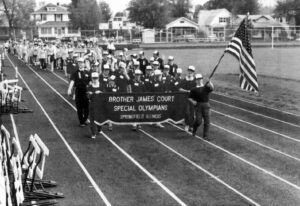
At Brother James Court the men attended Mass, took classes, including art and music, participated in sporting events and enjoyed various holiday events. Those who were able received vocational training. A track and field allowed them to train for Special Olympics events, which were very popular with the residents.
Residents thrived there for nearly 50 years, however in 2022, due to the ongoing complications and problems with illnesses of both the staff members and residents presented during the COVID pandemic, the brothers closed Brother James Court. “It was just a very difficult time,” Brother John Francis said. “Now we have a pollinator garden at the monastery that we put in, to honor of all the residents we had and the people who worked with them. It’s very beautiful.”
At one time St. James Monastery was home to as many as 16 brothers. Currently there are six brothers living at St. James Monastery: Brother John Francis, Brother Christian Guertin, Brother Stephen Bissler, Brother Anthony Joseph McCoy, Brother Boniface Shellock, and Brother Gerald Voycheck. Two other brothers are part of the community but live in Missouri. They are Brother David Sarnecki and Brother Raphael Kreikemeier.
At 68, Brother John Francis is the youngest among the American brothers. He’s been back at St. James Monastery for a year now, but prior to that he was away from Springfield and was general superior of the Franciscan Brothers of the Holy Cross and resided in Germany for six years.
Over the years many of the brothers have worked in the community and in parishes, and several held positions at the Catholic Pastoral Center in Springfield. “We say we don’t retire, we say we refocus,” he says, adding that a person’s age is only chronological. “We have brothers in their 70s and 80s who are very active.”
The brothers live like a family, and do their own cooking and cleaning, but they like to take Fridays off. “Brother Stephen and I do most of the cooking,” said Brother John Francis, who does majority of the shopping, and as the superior, also writes the weekly cooking and chores schedule for the monastery. “If one of the brothers has something special they want to cook, then they go to the store and buy it. I like to try new recipes, just so we aren’t having the same thing all the time.” He also does most of the baking and accompanies the brothers to medical appointments if they wish.
Like most religious communities, the brothers stick to a regulated schedule. They attend daily Mass together in the smaller chapel at the monastery and pray Morning Prayer at 6:30 a.m. and Evening Pray at 5:30 p.m., which is followed by dinner. Most of the time,Father Klemens Hasencox celebrates Mass and takes part in the brother’s activities.
Brother John Francis says his community is happy and content at home in Springfield and is looking forward to celebrating 100 years here in three years. “That’s right,” he said. “This is our home. We are staying here.”