
Former Adobe executive and deacon creates impressive Catholic digital platforms specifically for families — young and old
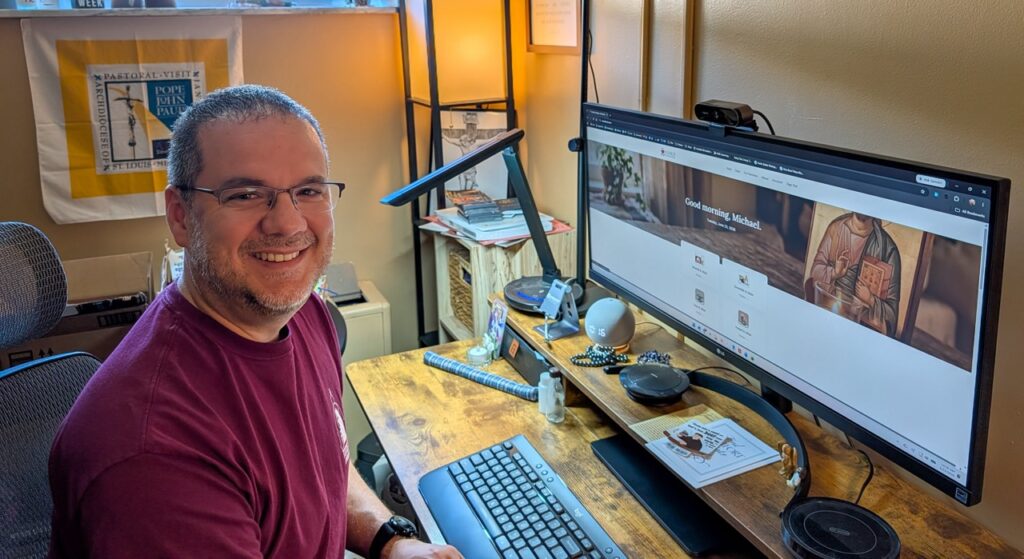
App, serial novel, short story series all part of Deacon Michael Halbrook’s Holy Spirit led mission
By ANDREW HANSEN
Editor
What if there were a Catholic platform designed not just for one type of person, but for the whole household? A place where a father, mother, teenager, young adult, or grandparent could all pray with the same liturgical day in ways shaped specifically for their stage of life.
That is the vision behind the growing work of Deacon Michael Halbrook, who recently stepped away from a longtime career with Adobe (a leading national software company) to focus full time on creating Catholic content rooted in prayer, formation, storytelling, and vocation. From daily prayer reflections and audio meditations to serialized Catholic fiction, saint-centered short stories, and leadership discernment resources, his projects are designed to help Catholics encounter the faith in deeper and more accessible ways.
In the following interview with Catholic Times Editor, Andrew Hansen, Halbrook, a deacon at St. Elizabeth in Granite City, who is married with four boys, explains the heart behind his projects, why you should take advantage of the Catholic content, and why he believes the Holy Spirit is calling Catholics to rediscover the beauty of the domestic church, the Communion of Saints, and daily life lived with God at the center.
Your main project is called Domus Formation. How is it helping Catholics in every stage of life grow in prayer and formation?
Domus Formation is a Catholic media company built around one conviction — that the domestic church, the household, is where formation actually takes root. Everything we do is designed to help Catholic households pray daily with the Church, in a way that’s faithful to the liturgy and realistic for ordinary life.
We meet people where they are. You can pray however works for your life — read the daily reflection on the web at WeAreDomus.com, get it delivered to your inbox as a morning email, or open it in our & Altar app on your phone (search “& Altar”). Every core reflection is also available as audio, so you can listen with your coffee, or a busy family can play it in the car on the way to school. It’s the same prayer for the same liturgical day — just shaped for how your day actually runs.
The content is organized into properties tailored to different states of life in the Catholic household. Hearth & Altar is for families with children at home. Iron & Altar is for men. Vessel & Altar is for women. Eventide & Altar is for elders. There’s Ostium Catholic for young adults, Young Disciples for teens, and Spanish-language equivalents — Hogar y Altar and Ocaso y Altar — because the domestic church speaks more than one language. Iron & Altar (for men), Vessel & Altar (for women), and Young Disciples (for teens) also have companion discussion guides that could be used in a small group each week — men’s groups, women’s groups, teens groups or “houses” in our Catholic high schools.
Every day, in every property, you get a short prayer reflection grounded in the Mass readings and the liturgical calendar. It’s the same prayer life of the Church, just shaped for whoever is praying it — a dad at the kitchen table, a teenager on the bus, a widow with her morning coffee.
Domus also has Deacon Life — a free online community for my brother deacons and Parish Prayers with universal prayer and resources for parishes.
Anyone can sign up at WeAreDomus.com. A household subscription covers up to six family members for $50 a year, with a free seven-day trial so you can try it before you subscribe.
How is this website/app different than other Catholic platforms? What makes it unique?
Two things, I think.
First, it’s formation through prayer for whatever state of life you’re in. Most Catholic apps are excellent at one thing — the Liturgy of the Hours, or the Rosary, or daily Mass readings. & Altar is built around the household, which means a husband and wife and their teenage son and their grandmother can all be praying the same liturgical day, but each in a way that meets them where they are. That’s the domestic church taken seriously as a place of formation.
Second, it’s simple on purpose. You don’t open the app and face 30 options. You open it and there’s one track of prayer for today, maybe two if you’re using the family track and the women’s or men’s track. The Church has already given us the readings, the feasts, the seasons — we just walk with her, day by day. In a lot of places through the year, the activity for a family is encouraging bringing back an old household tradition tied to the season or the feast.
I think a lot of people have downloaded beautiful Catholic apps and then quietly stopped using them because the menu was longer than the prayer. We wanted to do the opposite.
You also recently launched a fiction platform, Ordo: A Chronicle of Lux Perpetua. What is the story about and what themes are you exploring through it?
Lux Perpetua started as a serial novel and has grown into a Catholic fiction platform. The flagship work is a novel called Ordo: A Chronicle of Lux Perpetua, which I launched on Easter Sunday this year. It’s set right here in our part of the world — Alton, Illinois, with roots that reach back into the broader Catholic story. It unfolds across two tracks. The Living Thread comes out every Monday and follows the present-day story of Joshua David Maren, a 32-year-old historian who inherits his grandfather’s house on Candlemas and slowly discovers what his family has been keeping. The Lost Crown comes out every Thursday and is the historical documentary track — the older story Joshua is uncovering. The Living Thread is free; The Lost Crown is for paid subscribers.
What’s important to me in writing Ordo is what the story is actually about. The plot has its own pleasures — mystery, history, a young man piecing together his inheritance — but underneath it is something I think a lot of Catholics already sense. So much of what we’ve lost in our culture and our common life has been lost because we have thrown out the proper ordering of things — the order that we as Catholics know is inherent in God’s design for creation. Ordo is a story about a man slowly waking up to that, and to what is restored when the right order is restored. That has become the directional center of the whole Lux Perpetua project.
What makes this serial novel unique? Why do you think people would enjoy it?
Two things stand out, I think.
The first is that it’s genuinely Catholic without being preachy. The faith is woven into the world the characters live in — the saints, the sacraments, the rhythms of the liturgical year — the way it’s woven into real Catholic life. Readers who love the Church will recognize themselves in it. Readers who are curious about the Church will get to see it from inside the story.
The second is the format. Most novels arrive as a finished thousand-page brick. Lux Perpetua arrives a chapter at a time, twice a week, the way Dickens published. There’s a small authentication detail in the paid track called “The Seal” — a seven-digit code that expires at “Compline.” Little Catholic touches like that are part of the fun.
You also have a short story series, called Two Lamps. How does Two Lamps bring the Communion of Saints to life through fiction?
Two Lamps is a weekly short story series I publish every Friday morning at twolamps.org. Each story braids the lives of two saints — sometimes three — from different centuries, in a single piece of literary fiction. The saints I pair never met in life. The Communion of Saints is what makes the meeting real.
The form came out of a conversation with my son, Joseph, earlier this year. We started talking about writing plays or musicals about saints we wished could have known each other, what they might have said to each other if they had ever been in the same room. I turned that idea into this weekly short story series.
Each story is 2,500 to 4,000 words and meant to be read in one sitting on a Friday morning or a Saturday with coffee. The first issue, The Library at Echt, imagines St. Thomas Aquinas appearing to St. Teresa Benedicta of the Cross in the Carmel of Echt on the night before the Gestapo came for her. The second, The Tower at Beaurevoir, brings St. Matthias to St. Joan of Arc the night she chose to jump. The pairings keep coming — Newman and Vincent of Lérins on a train to London, Margaret Pole and Edith of Wilton in the Tower the morning of her execution, Charles Lwanga and Justin Martyr at Munyonyo, Ephrem the Syrian and Anthony of Padua at Camposampiero. By the time this piece prints in August, there will be more than 15 stories in the archive.
There’s a deliberate ambiguity in every story. You can read the older saint as actually present — an apparition — or as the patron-saint attending the younger from eternity through intercession. The text doesn’t decide for you. Both readings are theologically real, and I think holding them together is part of the gift the doctrine of the Communion of Saints gives us.
Every Friday story is free at twolamps.org. There’s a paid tier called Lamplight ($5 a month or $50 a year) with a monthly companion piece on the first Tuesday of each month — notes on sources, theology behind the pairings, what was cut, what surprised me.
Why do you think people would enjoy Two Lamps?
The saints are our family. That is the doctrine. The trouble is that for most of us, most of the time, our family in heaven feels more like a list of names than a household we belong to. Fiction is one of the ways that distance closes. When you read a story in which Aquinas and Edith Stein actually sit across a desk from each other and argue about straw and grain, the Communion of Saints stops being an article in the Creed and becomes a room you’ve been in.
I’m also enjoying writing something new for Catholic readers who love serious fiction and don’t often find it written from inside the faith. Each saint’s voice is researched and historically faithful —Aquinas dense and exact, Newman elaborate and Victorian, Vincent of Lérins terse and Latinate, Joan of Arc plainspoken and unbreakable. They argue in their own ways. The stories don’t always resolve the arguments.
It’s also rooted in this diocese in ways that may not be obvious. Joseph and I conceived the project here. The fifth-anniversary story for my diaconate ordination on June 26 pairs two of the great deacon saints of the Church — Lawrence of Rome and Francis of Assisi — on the mountain at La Verna. That one is for our brother deacons.
You left a stable job at Adobe to do all this. What is the inspiration?
The Holy Spirit has been putting these things into my heart every day in my Holy Hour for years. Deacon life was almost five years ago, and the prayer offerings started coming to me three years ago and accelerated over the last year. Suzanne, my wife, and I, and our boys, started talking about and discerning together what this might mean for my work and our family.
For years, I was doing two full things at once — a demanding corporate career and vocations both as a husband and father and as a deacon, with a growing sense that the Lord was calling me to build something in the second half of life that the first half couldn’t hold.
On Christ the King Sunday last year, after a novena, I consecrated everything I’m doing — every business, every project, every effort — to the Sacred Heart of Jesus. That’s the answer underneath all the other answers.
In February, when I was at Cathedral for our third grader’s confirmation and first Holy Communion, I was kneeling in the back pew praying during the adoration before the Mass. I begged our Lord, “If I take this leap, I just pray that I’ll still be able to provide for my family.” His answer came to me immediately: “Silly. It’s never been you that provided. It’s always been me that provided.” Matthew 6 tells us that if we seek first the Kingdom of God and His righteousness, that all we need will be provided. I’ve taken a complete leap into trusting that.
Domus Formation is the shape that work has taken. Lux Perpetua and Two Lamps and Ad Alta are part of it.
I’m not naive about the risks of leaving a 30 career in media, marketing, and tech, and an 18-year chapter in a secure role at a major technology company. Suzanne and I have four sons, as in and approaching college, and a mortgage, and the same bills everyone else has. But the consecration and the trust in God’s provision was not a slogan. It was a decision, and the work that’s flowing out of it has felt, from the first day, like the work I was made for.
Finally, to anyone reading this who is sensing the Lord calling them higher — verso l’alto —he means it. He’s good for it. Climb.