
7 things you didn’t know about each of the 7 sacraments
By Andrew Hansen (EDITOR), Father Dominic Rankin, and Father Daren Zehnle (rest in peace)
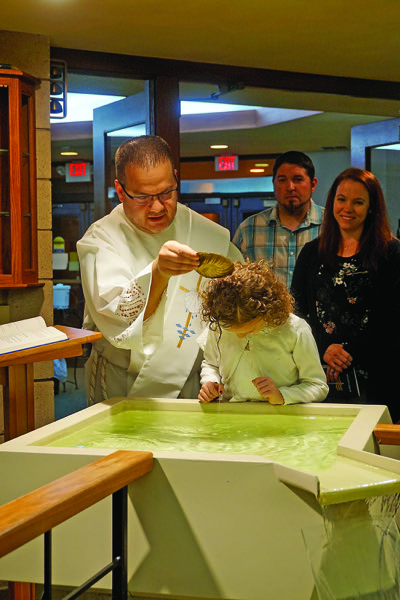 Baptism
- Anyone can baptize someone in the case of a danger of death. The Catechism of the Catholic Church (CCC) states, “In case of necessity, anyone, even a non-baptized person, with the required intention, can baptize, by using the Trinitarian baptismal formula. The intention required is to will what the Church does when she baptizes. The Church finds the reason for this possibility in the universal saving will of God and the necessity of Baptism for salvation” (paragraph 1256). The person must say, “I baptize you in the name of the Father, and of the Son, and of the Holy Spirit,” must pour water over the forehead of the person seeking baptism, and the person administering baptism must intend what the Church intends.
- The Code of Canon Law of the Catholic Church gives the requirements for being a godparent or sponsor of a person being baptized. Canon 873 states that “one sponsor, male or female is sufficient; but there may be two, one of each sex.” Canon 874 specifies the qualifications which are:
- Be appointed by the candidate or parents;
- Be 16 years of age, unless the minster determines otherwise;
- Be baptized, and then be confirmed and sharing in holy Communion in the Catholic Church and who practices the faith;
- Not have a canonical penalty;
- Not be the parent of the infant/candidate.
If married, a Godparent must be married in the Church or have their marriage recognized by the Church. A godparent’s role includes assisting the spiritual growth of the baptized person. So, make sure to choose someone who is practicing the faith!
- The Order of Baptism includes a prayer of exorcism. While not a major exorcism (think the movie The Exorcist), baptism includes a minor exorcism. “Since Baptism signifies liberation from sin and from its instigator the devil, one or more exorcisms are pronounced over the candidate. The celebrant then anoints him with the oil of catechumens, or lays his hands on him, and he explicitly renounces Satan. Thus prepared, he is able to confess the faith of the Church, to which he will be ‘entrusted’ by Baptism” (CCC 1237).
- The Catholic Church accepts baptisms done by other faiths as valid if they were done using the Trinitarian baptismal formula with the intention to do what the Church intends.
- Baptism forgives all sins that were committed before baptism, including original, mortal, and venial sins.
- Do you want to go to heaven? Better get baptized. “Baptism is birth into the new life in Christ. In accordance with the Lord's will, it is necessary for salvation, as is the Church herself, which we enter by Baptism” (CCC 1277). “Whoever believes and is baptized will be saved” (Mark 16:16).
- Baptism cannot be redone or undone (though some have attempted both throughout the Church’s history). Being plunged [baptizo] into the baptismal waters indelibly marks or stamps us with the character of someone who has been united with Christ in His death and promised – if we are open to it – a participation in His eternal life. “We were buried therefore with him by baptism into death, in order that, just as Christ was raised from the dead by the glory of the Father, we too might walk in newness of life” (Romans 6:4).
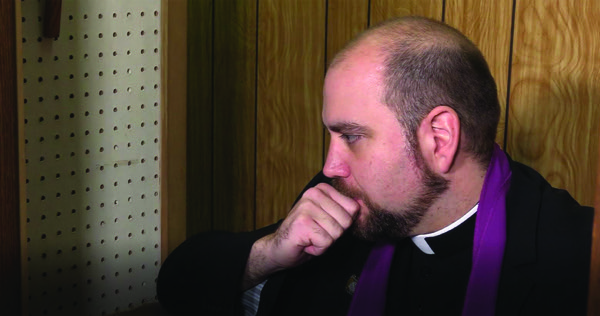 Confession
- Priests cannot reveal your sins to anyone. They will even go to jail or die over it. It's called the seal of the confessional. "The sacramental seal is inviolable; therefore, it is absolutely forbidden for a confessor to betray in any way a penitent in words or in any manner and for any reason" (Canon 983 §1). If a priest were to reveal sins, he would face automatic excommunication.
- In incredibly rare circumstances, absolution of one's sins could be imparted in a general manner to many penitents at once without individual confessions, but danger of death must be imminent, and there must be insufficient time for the priest or priests to hear the confessions of the penitents.
- In 2016, Pope Francis announced in an apostolic letter that priests have the authority to lift the excommunication incurred with the sin of abortion. Previously, one would have normally had to go to a bishop when seeking the lifting of the penalty, although priests in the Diocese of Springfield in Illinois had the faculty to lift the excommunication for decades.
- Priests wear a stole while hearing confessions. The stole, which wraps around their neck, symbolizes that they were given the authority and power to forgive sins as they sit in the place of Christ, who is both complete justice and mercy.
- Catholics are obligated to confess their grave sins at least once a year (Canon 989).
- There are many beautiful versions of the Act of Contrition (perhaps take a look at them to deepen your appreciation for this part of confession), but the penitent can also make that prayer in their own words, simply expressing to God sorrow and detestation for your sins and a resolution not to sin again.
- The greatest saints were not so holy that they did not need confession as often. They were holy because they went to confession often. Pope St. John Paul II and St. Teresa of Calcutta were both known for frequent reception of the Sacrament of Confession, often weekly.
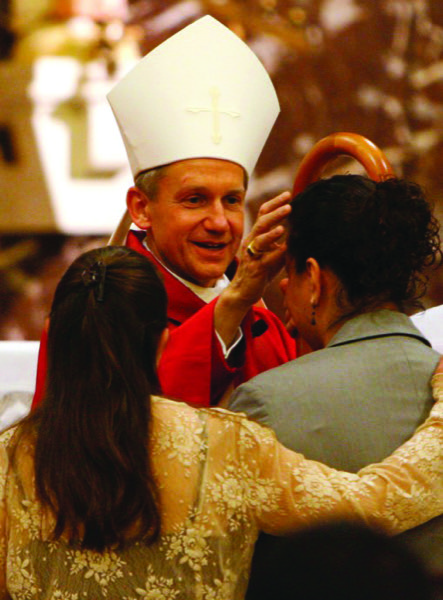 Confirmation
- Chrism oil, which is used to trace in the Sign of the Cross on a person’s forehead during Confirmation, has rich symbolism. In ancient history, when kings were installed, they were consecrated to their new status with oil. Likewise, at Confirmation, one is consecrated to their new spiritual status as a witness of Christ, using the seven gifts of the Holy Spirit received at Confirmation, to live a life centered on Christ. Those who are anointed with the sacred Chrism “share more completely in the mission of Jesus Christ” (CCC 1294). Also in ancient history, warriors in battle would cover themselves with oil to make it more difficult for the “enemy” to capture them. Likewise, Confirmation makes it more difficult for the devil to “catch” the person being anointed with oil as they are now filled with the seven gifts of the Holy Spirit. Oil also signifies healing and cleansing. Chrism oil also connects the person to their baptism when they were first anointed with oil.
- Olive oil is the typical oil used for sacred chrism (it’s used in our diocese). Balsam, a fragrant substance, is also added to give it a sweet smell.
- It became customary for those preparing for Confirmation to choose what we commonly call a Confirmation name. While not required by the Church, choosing such a name is a laudable practice and is commonly done in the dioceses of the United States. Because the one to be confirmed will be sent out “to confess the name of Christ boldly, and never to be ashamed of the Cross,” the idea is to choose the name of a Saint who can help fulfill this mission (CCC 1303).
- Those receiving Confirmation used to be gently slapped by the bishop. Yes, it’s true! Before the Second Vatican Council (1962), the bishop would slap the cheek of the person immediately after he or she was confirmed. It was used as a reminder to have courage as they were sent on a mission of living the Gospel. Now, the newly confirmed receive a handshake.
- The practice of receiving confirmation after first holy Communion is new in terms of the history of the Church, and it even goes against what the Church wishes. In the mid-19th century, bishops in France legislated to have the sacrament of Confirmation after first holy Communion. That practice spread throughout most of the world. Several dioceses, however, including the Diocese of Springfield in Illinois, have returned the order to its proper sequence as per the Catechism of the Catholic Church, "The holy Eucharist completes Christian initiation. Those who have been raised to the dignity of the royal priesthood by Baptism and configured more deeply to Christ by Confirmation participate with the whole community in the Lord's own sacrifice by means of the Eucharist" (CCC 1322).
- The term “Confirmation” does not refer to the confirmandi “confirming” their desire to live as disciples of Christ (though, of course, they should) but refers to the “confirming” of the confirmandi by God, clothing them with the power of God to be public witnesses of Him in the world. (CCC 1304).
- The sacrament of confirmation before the Second Vatican Council did not include a renewal of baptismal promises, but this has been added since the Council, so that it would be similar to the other sacraments that leave an indelible mark on the person (those being Baptism and Holy Orders, which both involve promises made by the person receiving the sacrament).
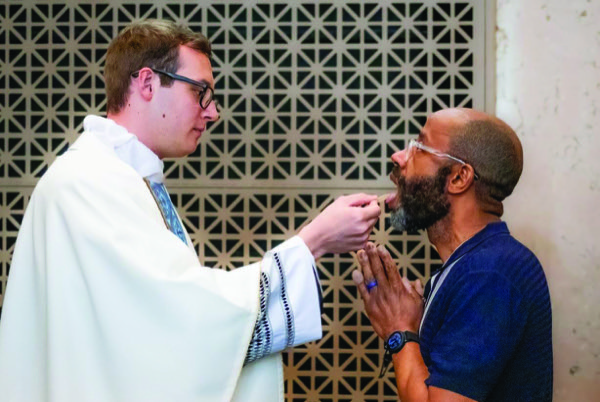 Eucharist
- In the Bread of Life discourse (John 6), Jesus first speaks of eating His flesh, and later uses an even more graphic verb that can be translated as “gnaw” or “chew.”
- Viaticum is the word used to describe someone receiving holy Communion who is severely sick on their deathbed. The word comes from a Mediterranean tradition of a meal shared by those who are going on a journey. In this case, the Eucharist is food for their imminent journey to meet God face to face.
- The word “Eucharist” comes from the Greek word for “Thanksgiving.” The Catechism of the Catholic Church (CCC) says, “The Greek words eucharistein and eulogein recall the Jewish blessings that proclaim - especially during a meal - God's works: creation, redemption, and sanctification” (CCC 1328).
- In 1910, St. Pope Pius X lowered the age limit for those receiving their first holy Communion. He changed it to “the age of reason,” which is typically about second or third grade.
- You can receive holy Communion a maximum of two times a day, as long as the second reception is at Mass and not a Communion service. However, holy Communion given as Viaticum can be received at any time.
- In the first centuries of the Church, belief in the Eucharist being Jesus’ own Body and Blood was so strong and universal that the Church Fathers, like Ignatius of Antioch, Justin Martyr, and Irenaeus, used the reality of the Eucharist as evidence against heretics who taught that the physical world was evil (the Gnostics and Manicheans) and that Christ did not really have a human nature, just the appearance of one (the Docetists).
- There have been dozens of Eucharistic miracles over the centuries, many of which include the host turning into physical flesh and physical blood appearing in the chalice. St. Carlo Acutis, who died in 2006, used his talents in computer programming and his love for the Eucharist to create a website that captures these miracle stories from around the world (miracolieucaristici.org).
 Marriage
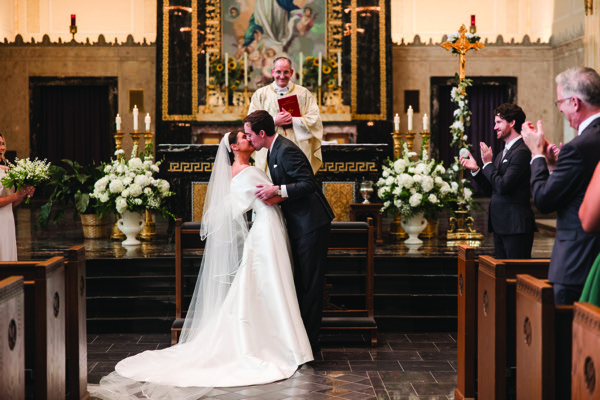
- This is the only sacrament where a deacon, priest, or bishop is not imparting the sacrament onto someone. It’s the couple who are imparting the sacrament on themselves.
- Catholics are to get married in a Catholic church. A dispensation from this is possible, but it must come from the bishop of the diocese, and it is only allowed in very rare and special circumstances. Because marriage is a sacrament, it is imperative that it takes place in the house of God (a Catholic church) and in front of God, who is truly present in the tabernacle.
- Research has found that married people tend to live longer than unmarried people; married people have better emotional and physical health than unmarried people; married people tend to have lower incidences of diseases such as diabetes, hypertension, and heart disease; marriage drastically drops the probability of child poverty; and children raised in intact married families are more likely to be physically and emotionally healthier.
- It has become a tradition that the married couple offers flowers to Mary by placing them at the base of a statue of her before the conclusion of the liturgy. Through this gesture, the couple is asking Mary to pray for them for a holy marriage. This gesture is also a reminder for the couple that Mary is a perfect model for them as she shows how to be faithful to God and trust in Him always.
- Wedding rings have long been a symbol of fidelity and enduring love. The practice of exchanging rings in marriage developed in the ancient world and was later adopted and reinterpreted by Christians. In the Christian wedding rite, the rings are exchanged as a “sign of love and fidelity,” symbolizing the lifelong covenant between husband and wife.
- The Sacrament of Matrimony does not include phrases like, “You may now kiss the bride,” or “I present to you Mr. and Mrs. ___,” because the reality of the couple being married is meant to be evident by their exchange of their vows and standing hand in hand before the altar.
- There are many married couples in the Church’s history where both spouses are known to be saints, now together in heaven! Joachim and Anne, Joseph and Mary, Zachary and Elizabeth, Aquila and Priscilla, Gregory and Nonna, Gordianus and Silvia, Isidore and Maria, Vincent and Waldetrudis, and Louis and Zelie Martin are just some.
 Holy Orders
- The youngest a man can be ordained a priest is 25 years-old without a dispensation from the pope. That's because after high school, some men called to the priesthood immediately enter college seminary for four years. Then, after college seminary, they go on to receive their theology degree which takes another four years.
- While in seminary formation, seminarians practice hearing a "confession." One seminarian "acts" as the penitent in the confessional while the other seminarian acts as the “priest,” hears the "confession," and then reacts and offers advice accordingly. Teachers and other seminarians will also watch this practice confession to help critique the seminarian acting as the priest to offer tips and advice.
- Celibacy for priests is not Church doctrine. It is called a discipline of the Church. Today, there are some priests who are married, but that is because they were married before they became Catholic. For example, Father Scott Snider of our diocese, is married. Father Snider was pastor of a Congregational church in Quincy when both he and his wife, Pamela, "became convinced that the fullest expression of Christ's intentions for what his church should be and do is to be found in the Roman Catholic Church," Snider said. Today, he is pastor of three small parishes in Adams County.
- Each priest has a spiritual advisor who is a priest. This not only allows a priest to discuss ideas, concerns, or troubles he may be facing, but it's also an opportunity for him to go to confession. Yes, priests go to confession, and they have to go to another priest to do so!
- Priests are required to pray the Liturgy of the Hours every day. While encouraged, they are not required to celebrate Mass every day. The Liturgy of the Hours is the Church’s public, communal prayer offered in the different hours of the day and night, consisting mainly of praise, supplication, psalms, readings, and intercession—the prayer of the Church with and to Christ.
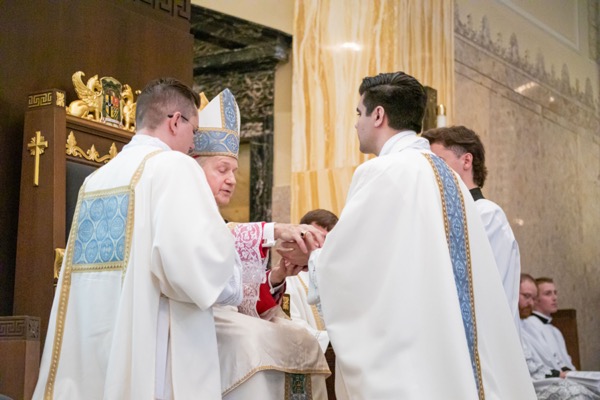
- The sacrament which makes a man a deacon, priest, or bishop is called “Holy Orders” not because those men are the only Christians who can be holy, but because those men are called by the Church to a particular way of being instruments for the holiness of others. The word “ordo” originally meant a specific sub-group within the Roman Army or society and the Church quickly began to use it to describe those who had been “ordered” and “ordained” to provide Christ’s sacraments and teaching to His Church.
- Why does a priest or bishop wear black clerical attire? The Code of Canon Law (p. 284) calls all clerics (though deacons are exempted in canon 288) to wear “suitable ecclesiastical garb,” with the United States Conference of Catholic Bishops making it clear that “a black suit and Roman collar are the usual attire for priests. The use of the cassock is at the discretion of the cleric.” Black attire is often associated with humility, simplicity, and a reminder of mortality, reflecting the priest’s call to live a life dedicated to God and service of His people.
 Anointing of the Sick
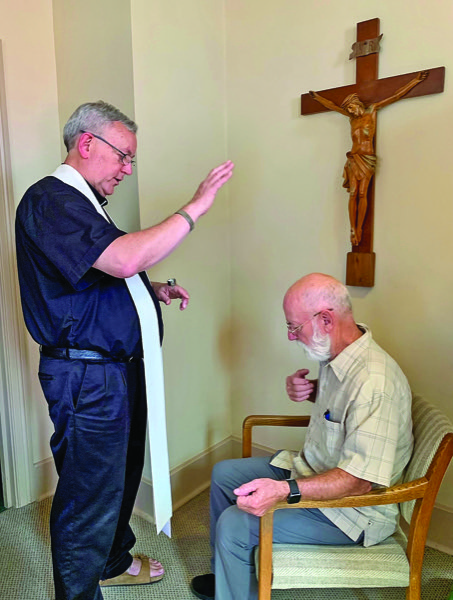
- This sacrament is one of two that offer healing and the forgiveness of sin (Confession being the other one). When one receives the Anointing of the Sick, the priest, with “duly blessed oil - pressed from olives or from other plants – will say, only once: ‘Through this holy anointing may the Lord in his love and mercy help you with the grace of the Holy Spirit. May the Lord who frees you from sin save you and raise you up’”(CCC 1513). The person receiving the anointing should say “Amen” after their forehead is anointed (“... Holy Spirit.”) and again after their palms are anointed (“... raise you up.”)
- One does not have to be on his or her deathbed to receive the sacrament of the Anointing of the Sick. In the Introduction to the Pastoral Care of the Sick, it says that “the sacrament may and should be given to anyone whose health is seriously impaired; on the other hand, it may not be given indiscriminately or to any person whose health is not seriously impaired.” It's important to note that while the sacrament is reserved for those who are “seriously ill,” that in and of itself is subjective. Therefore, priests of our diocese say that they would rather have you call one of them to ask for the Anointing of the Sick for you or for a loved one, than for you to ponder and debate if you or your loved one has reached being “seriously ill.” Too few people take advantage of this sacrament and unfortunately, sometimes, many people die without this great treasure of our faith because people waited too long or forgot to call a priest.
- Because the Anointing of the Sick confers absolution from sins, children who have not reached the age of reason, generally understood to be at seven years of age (canon 97 § 2), cannot receive the sacrament. As the Introduction teaches, “sick children may be anointed if they have sufficient use of reason to be strengthened by this sacrament” (12). This is why the Code of Canon Law says the Anointing of the Sick “can be administered to a member of the faithful who, having reached the use of reason, begins to be in danger due to sickness or old age” (canon 1004 §1).
- Families sometimes wonder if someone who is in a coma can receive this Sacrament. The faithful in such a condition can be anointed if they “at least implicitly requested it when they were in control of their faculties” (canon 1006). Even so, it is better to call for a priest before someone ends up in this state.
- You can receive this sacrament more than once and even for the same illness if it worsens. For example, if someone suffers from a chronic illness that places them in danger of death, they may receive the Anointing of the Sick at the beginning of the illness and again during the course of the same illness.
- The sacrament used to be known as “Extreme Unction” or “Last Rites.” Because the Church doesn’t want people to use the sacrament solely for people on the verge of death, after Vatican II in the 1960s, the Church returned to the origins of the sacrament, calling it “Anointing of the Sick,” using scripture as the basis: “They drove out many demons, and they anointed with oil many who were sick and cured them” (Mark 6:13).
- Typically, when anointing an individual, the priest traces the sign of the cross with holy oil on the person’s palms. If the one receiving the anointing, however, is himself a priest, the anointing would be done on the tops of his hands because his palms had already been anointed with Chrism at his ordination.