
He planned the funerals for five presidents and Pope John Paul II’s White House visit
Exclusive interview and podcast with Tom Groppel of Jerseyville
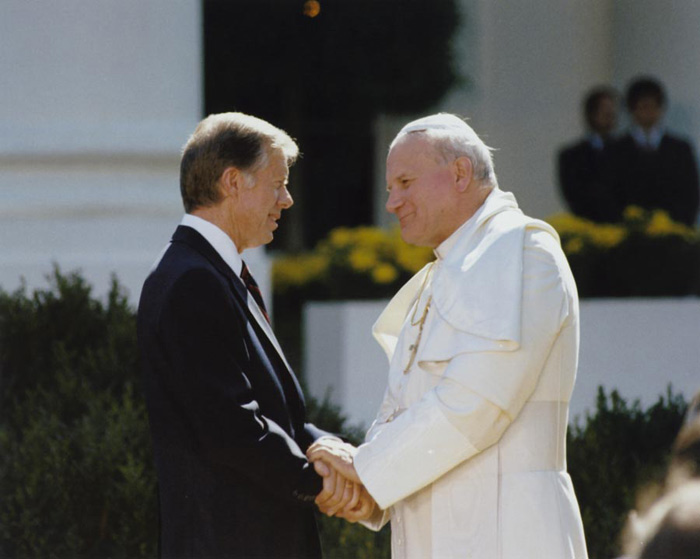
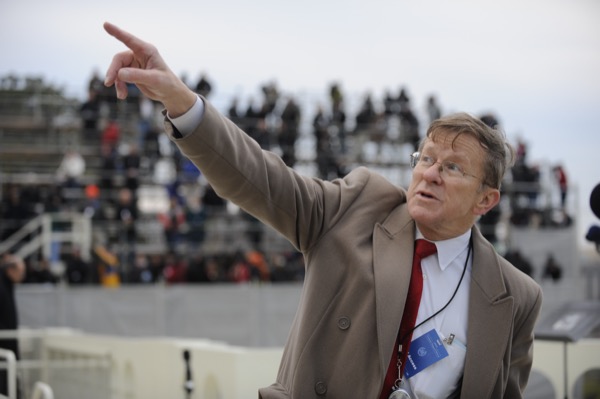
At first glance, Tom Groppel seems like an unassuming 82-year-old living quietly in the Jerseyville area on his farm, but behind that modest demeanor is a man who spent decades at the center of American history. Groppel served as Director of Ceremonies and Special Events for the Military District of Washington from 1986-2003, planning some of the nation’s most significant moments — state visits at the White House, presidential funerals, funerals for first ladies, and major events at Arlington National Cemetery. A Vietnam War veteran and former Army Ranger, Groppel helped coordinate the funerals of Presidents Richard Nixon, Gerald Ford, Jimmy Carter, Ronald Reagan, and George H. W. Bush, but among all the leaders he spoke with and encountered, one visitor to the White House stood above the rest: Pope John Paul II, who visited President Carter in 1979.
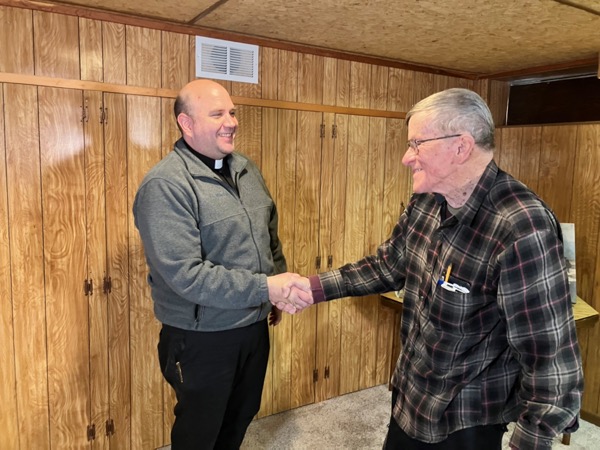
Andrew Hansen, editor of Catholic Times, visited St. Francis Xavier Parish in Jerseyville to interview Groppel, who has become close friends with the parish’s pastor, Father Marty Smith. Below are just a few questions Groppel discussed with Hansen in their nearly one-hour interview. Answers are edited for clarity.
Q. What was your role in planning John Paul II’s visit to the White House in 1979?
A. Heads of government/head of state normally arrive on the North Drive of the White House. There was a lot of discussion in the Carter House about the appropriateness of a military formation on the South Lawn. Even though the pope, to a minor extent, has a military connection with the Swiss Guard, it doesn’t quite relate to the same thing that we do on the South Lawn. So, I said in one of the meetings inside the Carter administration, “I don’t think anybody sees an identity with the military and Pope John Paul.” I said that even though he’s the head of state, technically he falls into a category that’s one of a kind. I said, “I don’t think so” (to the military formation).
Q. Why was he one of a kind? Take us to that day when he arrived.
A. Well, heads of government/head of state, either you’re royalty or you’re an elected official. To a lot of people, non-Catholics, the pope didn’t fall in that category. He’s not elected, and he’s not seen as royalty. So, he was one of a kind.
He wasn’t young and spry (during his visit). He moved carefully. It was beautiful day. The pope was coming to the White House from Capitol Hill. We could hear the sirens in the distance, and one of my subordinates, Rex Scouten, had everything all set on the North Lawn (for his arrival). Rex is just a nice guy. Nothing upset Rex.
Well, Father Marchenko, who was the advance person for the pope, he had Rex up in the corner (just before the pope’s arrival), and I walked in and Rex pointed to me, and he says, “He’s the one who can change the ceremony.” Father Marchenko turned to me, and he had this outburst about how things need to be more grand (for the pope’s arrival). I said, “Father, we’re not going to change one thing.” I said, “You agreed to everything we’re doing. You can hear the pope in the distance.”
I said, “I couldn’t change anything if I wanted to.” Father Marchenko had some four-letter words (for me), and I said, “My Father, you sure have a colorful vocabulary.”
The pope had a one-on-one with the Carters for some time. Then we went downstairs and went out, and he was introduced to the audience.
Q. Describe seeing the pope and the reactions from other people.
A. He radiated. President Carter was probably the most comfortable with his faith and his beliefs, and he was even struck by the pope. I said to the Secret Service, “Don’t ever assign a Catholic to protect the pope. They can’t turn their back on him!” I’ve never met another human that had that aura.
Q. You also took part in many burials at Arlington National Cemetery. You have an interesting story dealing with the Catholic Church in one of those instances.
A. Going back to World War II, the Germans invaded Poland. The head of the Polish government was Ignacy Jan Paderewski. He went into exile and went to Canada so not to be captured by the Germans. I guess for health reasons, he came to United States for medical help. He wrote a letter to President Roosevelt asking that (upon his death) would the U.S. allow his body to remain in United States until Poland’s free, and then send him home? President Roosevelt initials it and sends it over to the Department of Defense. So, we inherited Paderewski when he died in 1941. We had him under the Mast of the Maine, which is a monument at Arlington National Cemetery, and you could look through the little holes in the monument, and he’s in there on a pair of sawhorses, his casket was. Well, Poland becomes free, so I’ll send Paderewski home. The Poles had forgotten we had him. That was ancient history to them. So, I went to the State Department, and they notified the Polish government. So, we brought him out of the Mast of Maine, and we planned a Catholic church service.
Well, it just so happens that the chief of chaplains for the Army was a major general who was Catholic. So, I went to him and told him what I was going to do, and I said, “Since you’re Catholic, you can participate.” He said, “I’d love to.” So, I then set out to find a senior Polish (cleric) in the Catholic Church. He was a retired cardinal, I think out in New York. He came down. We did the rehearsal, and this retired cardinal had this major general — you’d think the major general was an altar boy! The cardinal had him running all over. And I kept thinking, “What in the world’s going on here?”
So, we’re done, everybody’s gone home, and I got the general aside. I said, “Sir, I think I owe you an apology.” He said, “Why?” I said, “The old cardinal had you running like an altar boy.” He said, “Tom, these two stars don’t mean a thing to the Catholic Church (pointing to his uniform).”
Preparing funerals for Richard Nixon, Gerald Ford, Jimmy Carter, Ronald Reagan, and George H. W. Bush
If you love history, American politics, and stories you have never heard before, watch Hansen’s entire exclusive interview with Groppel by scanning the QR code. In their nearly one-hour conversation, Groppel first shares stories of that John Paul II papal visit and Groppel’s conversations with each of these five presidents and their funeral arrangements.
Stories include how Bill Clinton’s Chief of Staff originally would not allow a presidential plane when Richard Nixon’s wife died and what changed his mind; why President Carter was the eulogist for President Ford’s funeral; why President Bush’s headstone looks so modest; where President Biden will have his funeral — and it’s not the Basilica of the National Shrine of the Immaculate Conception in Washington; and other stories you have never heard before regarding these important figures of American history.