
Pain led her to turn to Mary for intercession. After 99 years, her faith ‘is the most important thing’
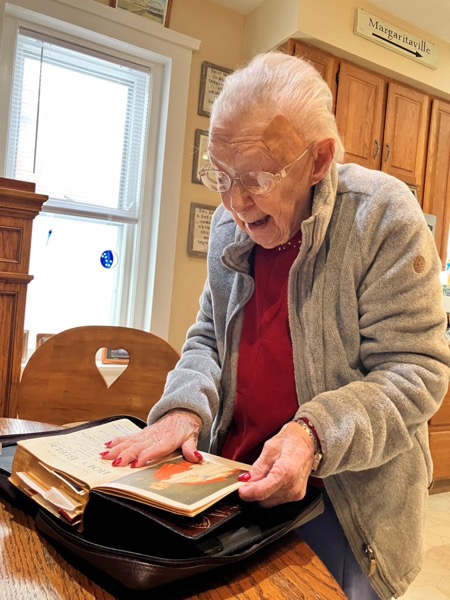
Springfield’s Doris Drago reflects on how faith keeps her going, receiving the Eucharist from St. Pope John II, and her advice for you
By ANDREW HANSEN
Editor
At 99 years old, Doris Drago of Springfield speaks about her Catholic faith not with fanfare or flourish, but with the calm certainty of someone who has lived it every single day.
Born July 24, 1926, in New Athens, along the banks of the Kaskaskia River, Drago grew up in a simple Catholic home where faith was learned first at the kitchen table. “My mother and dad were my first teachers, as far as my faith goes,” she said. Her father, a convert to Catholicism, modeled reverence and devotion — never missing Sunday Mass, always dressing in a shirt and tie.
There were no dramatic childhood miracles, she insists. Just faithfulness, Catholic education, prayer learned young, and prayer practiced often. Her faith would become the steady thread holding together a long life marked by both joy and deep trial.
That faith would be tested profoundly in 1957. In a moment of deep personal trial, when the weight of life and broken relationships pressed heavily upon her, Drago — then a young mother — was invited to place her trust more fully in God. Through her mother’s gentle encouragement, she attended a novena at the old St. Henry’s Seminary in Belleville on July 28, 1957, a night Drago would later say changed everything and marked the beginning of a deeper reliance on prayer. “Going to that first novena changed my whole life,” she said.
What began as a single evening of prayer became a lifelong commitment. Drago attended the novena faithfully year after year, never missing a night. Over the decades, she completed 60 novenas — each one being nine consecutive days of prayer. Through those prayers, especially the Rosary, she found healing, strength, and peace.
“I wasn’t a big Rosary person until I became a mother,” she reflected. Looking at Mary’s life, her suffering, and her faithfulness, Drago found a model for her own. “If Mary could do it, I could do it.”
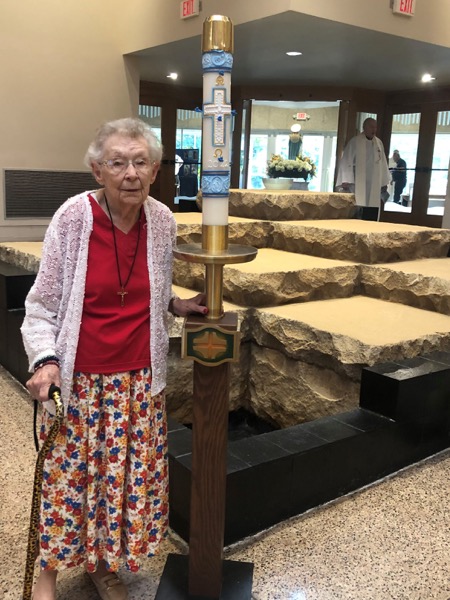
When the novena outgrew St. Henry’s, the devotion eventually moved to what would become the National Shrine of Our Lady of the Snows in Belleville. Doris was there from the beginning — before the grounds were finished, before the paths were paved, and before the shrine became what it is today. She volunteered wherever she was needed, weekend after weekend, while working full-time for a physician she served faithfully for 25 years.
Her role was never flashy. She passed out brochures, guided visitors, prayed with pilgrims, and of course, led the Rosary.
“There was something about going to that shrine that always made me feel good,” she said. “A quietness … a peace in your body.”
Asked why she gave so much of herself there, her answer was simple gratitude. “I wanted to give thanks to the Blessed Mother as much as I could for all her kindness and love and helping me through the difficult times of my life.”
Father Louis Studer, OMI, the current President of the Oblate School of Theology in San Antonio, Texas, first met Drago soon after he became Director of the Shrine of Our Lady of the Snows in Belleville in 1997. The two became great friends where they shared faith, prayed together, talked about life and its many challenges, and sometimes hardships.
“Doris was very generous throughout my 10 years as director, volunteering her time and energy at the shrine,” Father Studer said. “She volunteered to lead the Rosary every year for almost 50 years, especially at our novena Masses. She helped wherever she could, handing out programs, greeting guests, and was also very generous with donations and helping to sponsor various programs and activities.”
Today, Drago cannot get to the shrine due to her health, but Father Studer says she is greatly missed.
“Whenever I visit there, many ask about her, ask how she is doing and they know she keeps them in prayer because that was her promise to them. I know that promise to me too. We have stayed in contact. She asks me to continue to offer Masses for her intentions and the intentions of many people she continues to pray for.”
Though she never sought attention, Drago’s life of faithful service opened the door to moments in the life of the Church that most Catholics only read about.
In 1995, she was invited to Rome when Eugene de Mazenod was canonized a saint and there, she received holy Communion from St. Pope John Paul II.
“I decided I would keep my eyes open while I received the Lord,” she recalled with a gentle smile. “I looked at Pope John Paul II, and he looked at me. Pope John Paul II had the bluest eyes I ever saw in my life.”
She returned to her seat grateful, awed, and thankful for such an experience.
Drago was also present in Rome when the late Cardinal Francis George of the Archdiocese of Chicago received his red hat in 1998. Drago had met Cardinal George at the shrine years earlier. She stood in St. Peter’s Square, surrounded by the Church universal, witnessing a moment few ever see. “When you walk into that area, there is something you can’t explain,” she said. “But it’s there.”
Through it all — raising her daughter, ensuring a Catholic education for her family, welcoming a granddaughter, and a great-granddaughter, enduring illness and injury — Drago’s faith has remained deeply personal and deeply consistent.
“My faith is the most important thing to me in my life,” she said.
Asked what she loves most about being Catholic, her answer reflects a lifetime of prayer more than theology: “You feel it in your heart. You know that you’re on the right path.”
Her advice, earned over nearly a century, is both practical and profound.
To parents: “Take the time to talk to your children … explain right and wrong, truth and false. You’ve got to take time.”
To a restless world: “Don’t criticize, pray. Accept people as they are and be thankful you can pray for them.”
And to everyone: “Everything you have comes from almighty God. Be thankful when you go to bed at night for what He has given you this day.”
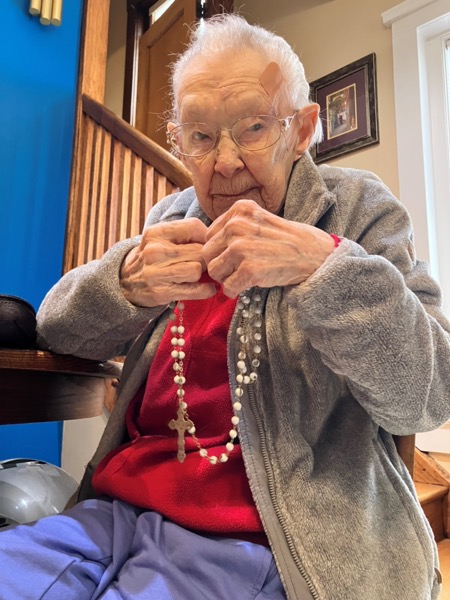
Now living with her daughter in Springfield, Drago still prays the Rosary daily, often twice a day. She begins each morning greeting the Father, Son, and Holy Spirit, and ends each night thanking God for the day just lived. She remains attentive to history, current events, and the life of the Church.
“I thoroughly believe in my heart that almighty God does help the people in this country if they will turn to him and ask for help,” Drago said.
Today, she is a parishioner at the Cathedral of the Immaculate Conception in Springfield, although she cannot always get to Mass due to her health.
“I am very thankful to Almighty God that He has given me these years to live.”
In a world that often prizes loud voices and fleeting influences, Doris Drago’s life offers a quieter witness — one built on prayer, perseverance, and trust. At 99, her testimony is clear: faith lived faithfully is never ordinary, and grace, when received with humility, can sustain a lifetime.