
The remarkable conversion story of Father Scott Snider, and his Wife, Pam
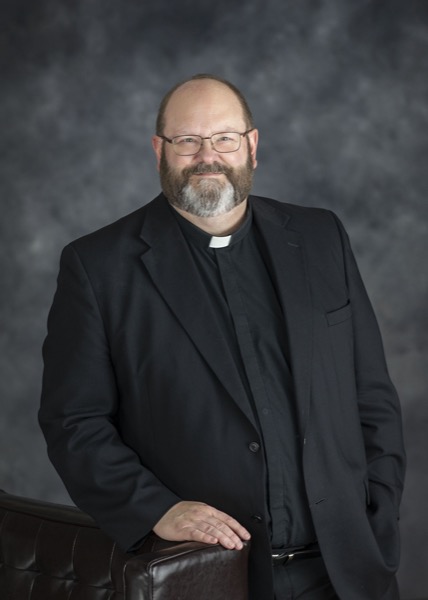
‘From day one, we’ve been so happy being Catholic’
The remarkable conversion story of Father Scott Snider, a married Catholic priest, and his wife, Pam
By ANDREW HANSEN
Editor
When Father Scott Snider walks into a parish gathering, he’s used to getting a few puzzled looks. “You’re a married priest?” people often ask, eyebrows raised.
“That generally leads to some really interesting conversations,” he says with a smile. “The first question is usually, ‘Are you a Catholic priest?’— with the emphasis on Catholic.”
Indeed, Father Snider’s story is rare not only in the Diocese of Springfield in Illinois, but across the Catholic world. A convert to the faith, a longtime Protestant minister, and now pastor of St. Brigid in Liberty, St. Edward in Mendon, and St. Joseph in Quincy, Father Snider embodies the surprising, often winding path of God’s call.
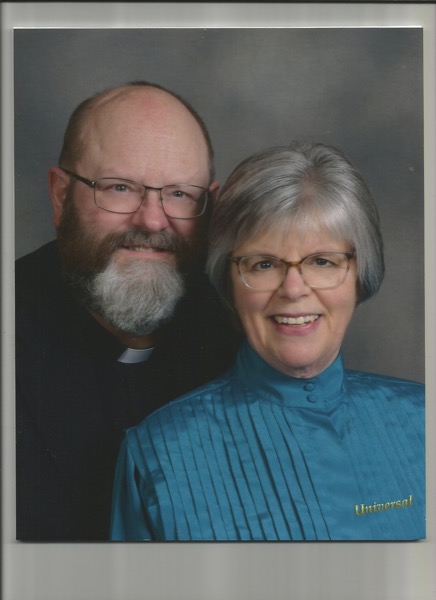
He and his wife, Pam, have been married for more than 40 years. Their shared journey has taken them through multiple denominations, several states, and ultimately — by the grace of God — into full communion with the Catholic Church.
“I grew up in a believing family,” Father Snider recalls, “But we didn’t really attend church that much.”
It wasn’t until age 17 that he was baptized in the American Lutheran Church, a branch that would later become part of the Evangelical Lutheran Church in America (ELCA). Almost immediately after his baptism, others saw something in him.
“As soon as I started working in the church, people told me, ‘Scott, have you ever thought about being a pastor?’” he says. “I told them ‘No,’ but after my first year in college, I felt God calling me to ministry.”
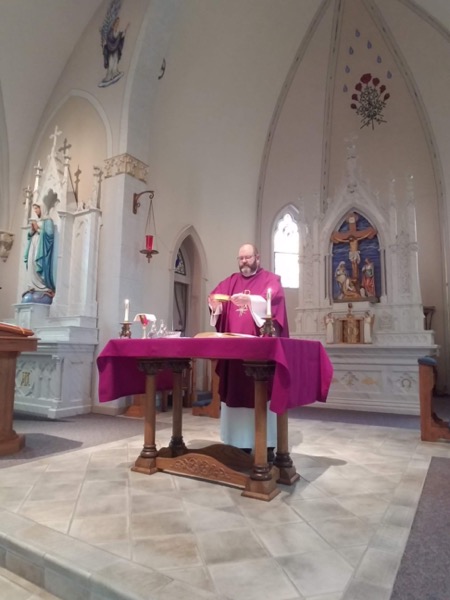
He entered seminary in St. Paul, Minn., but left after a year, unsure. He then worked in Lutheran parishes in Minnesota and Texas, focusing on youth ministry and Christian education. Yet, even as he served, something deeper stirred.
“I started questioning the Protestant church,” he explains. “I was seeing theological things that troubled me. I couldn’t put it into words at the time, but I felt like maybe I was too conservative for the ELCA. Eventually, I came to see it wasn’t about conservative or liberal — it was about authority. Where is authority in the church?”
That question would define his spiritual journey for years. Snider and Pam visited multiple denominations.
“We attended a Pentecostal church for a while — wonderful people, very alive in faith — but it wasn’t for us,” he says. “Then we went to a Presbyterian church. Again, good people, but I realized this wasn’t a Lutheran problem. It was a Protestant problem.”
“What led us to be open to other options was frustration with the direction that Protestant churches were going in,” Pam said. “In 1997, a Lutheran pastor with whom Scott was meeting weekly for prayer, shared a couple of books with him about Eastern Orthodoxy. We both read them and explored that avenue off and on for about five years. Four years into considering Orthodoxy, a friend shared two books with us about converts to Catholicism: Surprised by Truth by Patrick Madrid and Rome Sweet Home by Dr. Scott and Kimberly Hahn. The Catholic books resonated with me in a way that the Orthodox books had not.”
While serving as a pastor in northern Minnesota, he met regularly for prayer with a Lutheran colleague who was himself exploring Catholicism. “He had books on the Orthodox Church, and I was reading about Eastern Orthodoxy too,” Snider says. “We both felt the same unease — this drift in Protestantism, this lack of a center to say, ‘This is what the church believes.’”
Later, as pastor of First Union Congregational Church in Quincy, a historic church dating back more than 180 years, Snider’s restlessness grew.
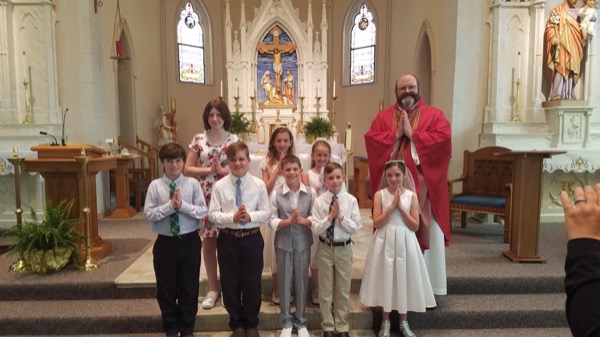
“It became clear to us that the Protestant churches couldn’t hold onto the apostolic faith because they didn’t have the apostolic office— the bishops,” he says. “That’s their reason for existence: to pass on the apostolic faith they have received. We also realized they didn’t have the office of unity, which is the pope. Jesus prayed that we would all be one — and the pope is the visible sign of that unity.”
Pam, who had been raised Lutheran, was discerning alongside him. “Every step of the way, we’ve gone together,” Father Snider says. “Every thought I’ve had, we’ve talked through together.” In 2002, the couple made their decision: they would become Catholic.
It was not an easy choice. “When I told the elders of my church in Quincy that we were becoming Catholic, I thought it would be the hardest three months of my life,” he remembers. “But it turned out to be beautiful. People came up to me and said, ‘Scott, why are you doing this?’ And I could tell them it’s not because I don’t think they’re Christians. It’s because all of the gifts God wants to give to His Church are present in the Catholic Church.”
Leaving meant leaving his job. “That was a tough time — probably harder on Pam than on me,” he admits. To make ends meet, he worked at County Market in Quincy and later took a job with a fundraising company before moving to Chicago to serve as a pastoral associate at St. Gregory the Great Parish. It was there that another life-changing moment arrived.
During his time at St. Gregory’s, Snider’s pastoral team received a grant for continuing development. Each member could use part of the funds for personal spiritual growth. “I asked permission to do the 30-day Ignatian silent retreat,” he says. “That’s where I brought my big question: Should I pursue priesthood?” Thirty days later, the answer was clear. “Yes.”
When he returned home, he told Pam. Her reaction? “OK,” he says, smiling. “Pretty much that. But she’s incredibly supportive. She’d been a minister’s wife before, so she knew that life. I always say she’s holier than I am, and I’m pretty sure she’s got nothing left in purgatory.”
Returning to the Diocese of Springfield in Illinois, where their Catholic journey began, Father Snider approached then Bishop George Lucas (now Archbishop Emeritus of Omaha). “He was immediately supportive,” Father Snider recalls. “We began the process of receiving the necessary permissions from the Vatican. I needed permission to begin studies and, later, for ordination.”
That permission came from none other than Pope Benedict XVI himself.
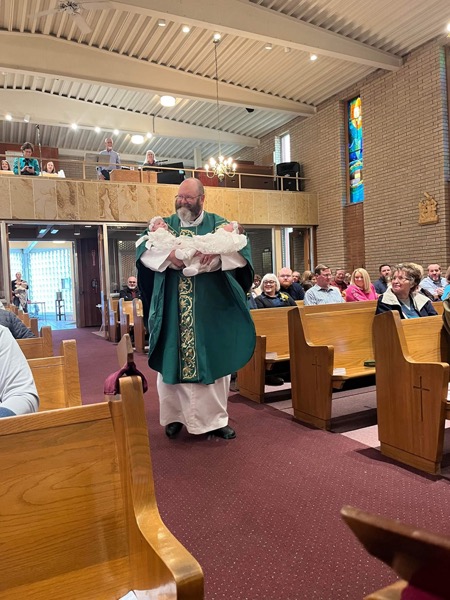
“All the guys at seminary said, ‘Wow — Pope Benedict knows your name!’” he laughs. In 2012, Father Snider was ordained a Catholic priest.
So, what’s it like to be a married priest? “It’s been wonderful — absolutely wonderful,” he says. “In some ways, it’s probably been easier for Pam, because in Protestant churches, the minister’s wife comes with a lot of expectations — leading the women’s group, the choir, the Sunday school. But now,” he chuckles, “nobody knows what to do with Pam. She just prays for everyone, which is probably the most important thing.”
“Being married to a priest is like being married to a pastor,” Pam said. “I had been a pastor’s wife for seven years. Coming from a Protestant upbringing, this is not unusual or surprising. Shortly after Father Scott was ordained a woman asked me, ‘What’s it like to see him up there, presiding at Mass?” I said, ‘It’s a relief. This is what he is gifted for.’
“The typical reaction I get from Catholics when I tell them I’m married to a priest is a nonplussed expression. Most people don’t know that this provision exists for married, former Protestant clergy who have become Catholic to be allowed into the Roman Catholic priesthood. In the parishes that Scott has served since being ordained in 2012, we have both been welcomed warmly.”
As for the ongoing conversation about married priests and celibacy, Father Snider offers a deeply Catholic perspective.
“It’s more and more being recognized what a gift celibacy is to the Church,” he says. “The discipline didn’t come about lightly, and we shouldn’t dismiss it lightly. In my case, and for clergy who come from other denominations, it’s an exception — pastoral in nature.”
He points out that the allowance for married Protestant ministers entering the Church began after World War II and continues under certain conditions today. “All of these are exceptions to the rule of celibacy, which has never been questioned,” he emphasizes.
Father Snider also reflects on misconceptions about married clergy.
“Some people worry that a married priest would be pulled in two directions,” he says. “But no priest has the strength to do this job on his own. It’s the gift of the Holy Spirit at ordination that makes it possible. And as for being pulled in two directions — well, no. Pam has great spiritual depth, and that makes everything possible.”
He adds, “When we talk about spiritual fatherhood — being a father, whether natural or spiritual, comes from the Holy Spirit. You’re able to be a good father because God gives you what you need.”
While some argue that allowing married priests might fix vocations shortages, Father Snider, who lives in Liberty, isn’t convinced.
“Most Protestant denominations are also experiencing shortages,” he says. “So that’s not going to solve the problem. Vocations are about answering God’s call, not a lifestyle choice. It’s not, ‘I’m choosing this for my life.’ It’s, ‘God has chosen me for this.’”
For Pam, she supports Father Snider in various ways such as managing the home to being involved in the parish.
“I have a prayer I say before each Mass that is derived from two passages of Scripture. 1st Samuel 3:19: ‘And Samuel grew, and the Lord was with him and let none of his words fall to the ground.’ And from St. Paul’s prayer for the faithful in Ephesus taken from Ephesians 1:17-18a: ‘That the God of our Lord Jesus Christ, the Father of glory, may give you a spirit of wisdom and of revelation in the knowledge of him, having the eyes of your hearts enlightened.’ I condense this to a petition/blessing for Father Scott and for the congregation, ‘May his words not fall to the ground, and may the eyes of our hearts be enlightened.’”
Now more than a decade into his priesthood, Father Snider is deeply content.
“It’s the best thing ever,” he says with a wide smile. “From day one, we’ve been so happy being Catholic. Every week, we discover something new to be grateful for in the Church. We’re just very happy.”
His life, in many ways, is living proof of what he once went searching for — a Church with authority, unity, and the fullness of faith, and for this married priest, that fullness has brought not only peace, but joy.
For Pam, she loves the beauty of the faith, especially “the silence before Mass.”
“I love that people come in to pray,” she says. “This reverent and respectful practice helps us focus and prepares our hearts for a deeper encounter with God in the Mass.”