
What makes the image of Our Lady of Guadalupe so mysterious?
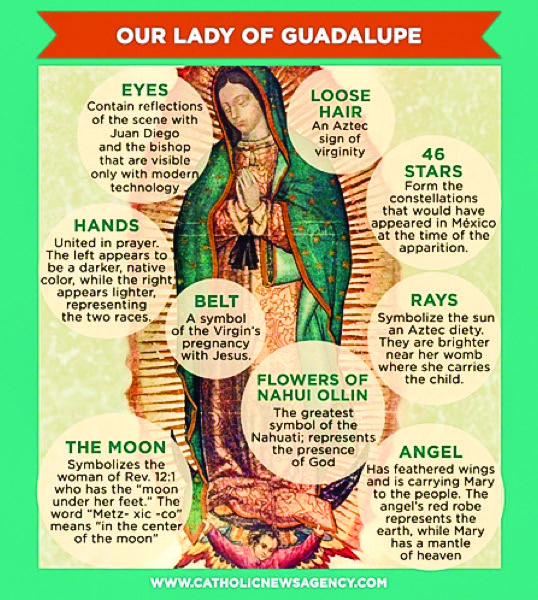
Feast of Our Lady of Guadalupe celebrated Dec. 12
By JONAH McKEOWN
Catholic News Agency
In 1531 a “Lady from Heaven” appeared to St. Juan Diego, a poor Indian from Tepeyac, a hill northwest of Mexico City. She identified herself as the Mother of the True God and instructed him to have the bishop build a church on the site. As a sign for the bishop, she left an image of herself imprinted miraculously on his tilma, a poor-quality cactus-cloth. The tilma should have deteriorated within 20 years but shows no sign of decay after nearly 500 years. To this day it defies all scientific explanations of its origin.
It wasn’t until the image of Our Lady of Guadalupe appeared that the native people began to accept Christianity on a large scale. Today, the image forms an inextricable part of the history of Mexico and facilitated the evangelization of an entire people.
In the 1530s, Juan Diego was a native man in his 40s and a member of one of the first native tribes to be baptized. While passing on a December day by Tepeyac Hill, he heard a beautiful voice calling to him. When he reached the summit, he saw a woman there who spoke to him in his native tongue and told him that she wanted a chapel built there.
Juan Diego delivered the message to the local bishop, who didn’t believe him at first. Diego returned to the hill, and at Mary’s direction, found roses growing on the hill, even though it was winter. He gathered them into his cloak, or tilma.
When he unfurled the cloak in the presence of the bishop to show him the roses, a miraculous image of Mary was on the tilma.
Mary herself used the name “Guadalupe.” Guadalupe was the name of a shrine in Spain, a fact which surprised the Spaniards. Spanish, Italian, and French artistic influences can be detected in the work. The Spaniards perceived the image as a Christian icon, full of intelligible Christian symbols such as the imagery of the moon at Mary’s feet and the blue of her dress.
A basilica was built at the base of the hill, which eventually began to crumble. A new basilica was consecrated in 1976.
The mysteries surrounding the tilma are innumerable, and many have been tested or brought to the forefront thanks to scientific inquiry.
For example, astronomers have determined that the arrangement of stars on the Guadalupe image corresponds to how the stars would have appeared on Dec. 12, 1531. In addition, some of the flowers on the tilma correspond to the locations of volcanoes in Mexico, something no one at that time could have mapped with such accuracy.
Under great magnification, shadowy figures have been discerned in Mary’s eyes, at a scale not possible for a human painter to have made. Various analyses have suggested a bearded man, and even several other figures (it is believed to be the images of Juan Diego, Bishop Juan de Zummaraga, Juan Gonzales-the interpreter and others), with the tiny images conforming to optical laws not known until the 19th century — such as the reflection patterns in real human eyes.
There is no under sketch, no sizing, and no protective over-varnish on the image. Microscopic examination revealed that there were no brush strokes. The image seems to increase in size and change colors due to an unknown property of the surface and substance of which it is made. According to Kodak of Mexico, the image is smooth and feels like a modern-day photograph — produced 300 years before the invention of photography. The image has consistently defied exact reproduction, whether by brush or camera.
Another baffling mystery is the tilma’s longevity. The cloak shows almost no signs of aging, despite the fragility of agave thread and the fact that the image was kept, unprotected, in a smoky, salty environment for over 100 years, seen and touched by thousands of people. Science cannot explain the tilma, to this day.
Other, more miraculous occurrences have borne witness to the cloak’s resilience. At one point in 1785 when the frame was being cleaned, nitric acid spilled on it by accident, but it left no permanent stains.
A man once tried in 1921 to blow up the image by detonating dynamite in the church, but despite the church practically crumbling around it, the image was unharmed.
Each year an estimated 10 million people visit her Basilica, making her Mexico City home the most popular Marian shrine in the world, and the most visited Catholic church in the world after St. Peter’s Basilica in the Vatican.
The Feast of Our Lady of Guadalupe is celebrated on Dec. 12. In 1999, St. Pope John Paul II, in his homily given during the Solemn Mass at the Basilica of Our Lady of Guadalupe, his third visit to the sanctuary, declared the date of Dec. 12 as a Liturgical Holy Day for the whole continent. During the same visit, Pope John Paul II entrusted the cause of life to her loving protection and placed under her motherly care the innocent lives of children, especially those who are in danger of not being born.
Our Lady of Guadalupe, pray for us!