
War stories from naval chaplain, Father John Burnette
‘It’s the most satisfying experience I’ve ever had’
By ANDREW HANSEN
Editor
On a warm night in the Persian Gulf, Father John Burnette, a Navy chaplain climbed up to the crow’s nest of a troop carrier. The sea was calm, the stars infinite, and the world below seemed to vanish into a blur of black ocean and sky. Standing beside him was a young sailor whose eyes were supposed to be scanning the horizon for threats. But her heart and mind were on something else: marriage. She turned to Father Burnette in the quiet and asked a question not found in any military manual: “Hey, Chaps, how do you know when you’ve met the right one?”
For a moment, war faded away. The training, the engines, the drills — all disappeared as they talked. For half an hour, priest and sailor stood under the stars, speaking of love and vocation, of discernment and marriage. “It was kind of like coaching people before marriage,” Father Burnette remembered, “but just having one of them there.”
When asked what that moment meant to him, Father Burnette’s voice softened: “It’s nothing that can be repeated. An unrepeatable experience. I didn’t sit in an office and wait for people to come to me. The ship was mine. And that’s where ministry happened.”
The road to chaplaincy
Father Burnette’s path to moments like that began in June 2001, when then Bishop George Lucas of the Diocese of Springfield in Illinois gave him permission to enter active-duty service as a Navy chaplain. He started as a lieutenant, first completing Chaplain School in Newport, R.I. “It was an awesome place to be in the summertime,” he recalled, remembering days of training mixed with sailing and beaches.
His first assignment came quickly. He was sent to Bahrain, a small island nation off the coast of Saudi Arabia, home to a joint U.S. naval base. Father Burnette landed late on the night of Sept. 10, 2001.
“The very next day was 9/11,” he said quietly. “I watched the second tower fall from my hotel room in Bahrain.”
The world changed, and so did his assignment. Instead of routine chaplaincy, he found himself in a tense region now at the heart of the U.S. military response to terrorism. The base hosted every branch of the U.S. armed forces, plus NATO allies and the Coast Guard, and every day was different.
“A typical day would be an atypical day,” Father Burnette laughed. Some mornings began before dawn with emergency response training — running miles in gas masks under sweltering heat, practicing hazardous material cleanup, rappelling from tall buildings, training with firefighters. “It was better than Six Flags,” he said with a laugh, but serious at the same time, “because it was real.”
And yet, at the heart of it all, he was still a priest. At noon, he celebrated Mass, often with a dozen military members from across the branches. On Fridays — the Muslim holy day — he offered what counted as Sunday Mass so Catholics wouldn’t fall out of rhythm with the rest of the troops. His small apartment became a gathering spot for Bible study. “Those were good days,” he said, “because faith anchored us amid everything else.”
He would remain in Bahrain for 19 months, the last three spent at sea with a Marine amphibious group preparing to enter Iraq. Though he transferred before crossing the border, the experience set the tone for years of ministry alongside sailors and Marines in every corner of the world.
Priest at sea
From Bahrain, Father Burnette’s path took him to the USS Harry S. Truman Carrier. He joined the ship off the coast of Sicily, flown in by a carrier-onboard delivery aircraft. “Planes don’t land on ships — they’re caught or trapped,” he explained, describing the tailhook that grabs a cable on the deck. “It was awesome.”
For two years, he lived the rhythm of carrier life. Father Burnette loved making rounds on the bridge, going for long talks with the captain, as well as on the flight deck, before, during, and after flight operations, and with the basic sailors of the deck department. Evening prayers came each night at 9:55 p.m., broadcast across the ship’s intercom. Sunday Mass was celebrated at 8 a.m. (it was at 8 a.m. when the captain arrived). Until he arrived, they sang hymns.
That presence — visible, approachable, constant — opened doors for pastoral encounters. “The military people gravitate toward the chaplains they see,” he reflected. “Not the ones trying to be one of them, but the ones who are there, visible.”
One night that presence meant holding the hand of an 18-year-old sailor whose palm had been crushed around midnight beneath the wheel of a 20-ton fighter jet. “His hand looked like hamburger,” Father Burnette remembered with a wince. The boy’s only request: “Chaps, just hang on to my hand.”
He wasn’t Catholic, but he knew the chaplain, and in that moment, pain and fear dissolved into the simple comfort of another’s presence. “He squeezed my hand so hard,” Father Burnette recalled. Surgeons stabilized the injury through telemedicine with a U.S. based doctor before flying the sailor to a hospital for further care.
“It was a blessing,” Father Burnette said. “He asked for me — not because of what I could do medically, but because I was there.”
Afghanistan: A new battlefield
After years of service at sea and in Asia, Father Burnette returned briefly to parish life in Quincy, Illinois, but in 2010, the Navy involuntarily recalled him for active duty in Afghanistan.
Weeks of training prepared him: maps, compasses, survival tactics, and Afghan culture. He also learned how to walk without triggering improvised explosive devices. By November, he was stationed at Camp Leatherneck, a sprawling joint base in the Helmand Province of Afghanistan.
Every evening brought ramp ceremonies, sending home caskets of fallen service members. “You think, it could be me,” Father Burnette admitted, but he did not dwell on fear.
A single Scripture passage anchored him: “Perfect love casts out all fear” (1 John 4:18). He reflected: “It’s not my perfect love for God, but God’s perfect love for us that casts out all fear. From that time on, I really didn’t have a lot of fear.”
Even when a helicopter he was on came under fire and gunners had to return fire mid-flight, Father Burnette felt calm. “Either I’d come home complete, or with an injury, or in a box. That’s what you do.”
The sacraments in the desert
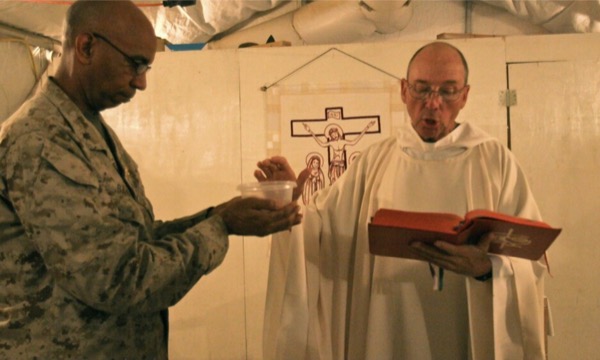
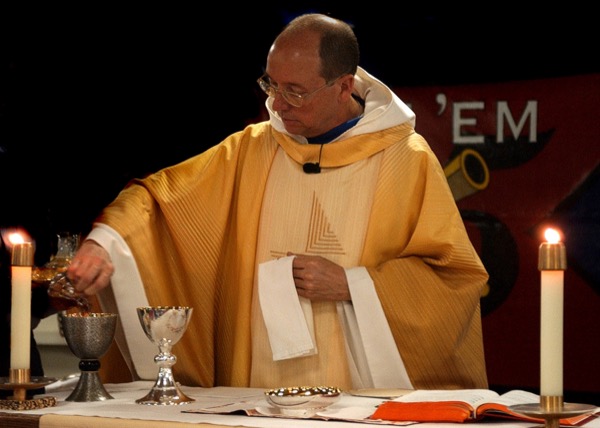
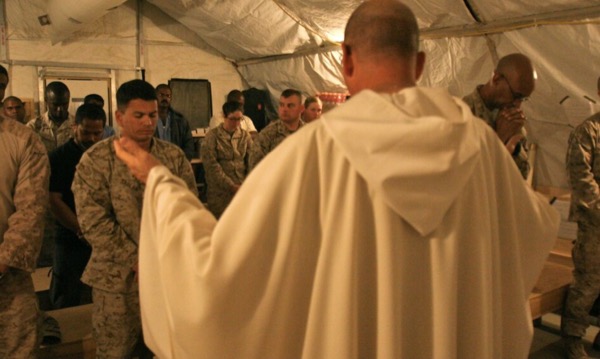
For many Marines, Father Burnette was the only priest they would see for weeks. He carried a Mass kit when he traveled, setting up makeshift altars on MRE (Meals, Ready-to- Eat) boxes with plywood tops. “It needs to look holy for them to experience the holy,” he explained. “It’s not ordinary.”
At Christmastime, he once celebrated eight Masses in one day, traveling from base to base. On Christmas Day, after finishing a liturgy at a forward operating base, a Marine approached, his face falling when he was told that Mass had just ended. Seeing his disappointment, Father Burnette asked if he wanted to go to Mass. “Yes, Father, please,” the marine responded. So, the priest offered another.
“It still touches my heart,” Father Burnette said. “He wanted Jesus, and I was blessed to bring Him.”
Confessions, too, were sacred. “With the military, most of them know what’s right and wrong,” he explained. “They get that sense of sin and need to get rid of it. Being there for confessions — that was the greatest blessing.”
Witnessing loss
Not all memories were joyful. Father Burnette still mourns a Marine he had come to know well — a young man who once studied for the priesthood before becoming a dog handler. Leading patrols with a bomb-sniffing dog, he was killed by a sniper.
“It was heartbreaking,” Father Burnette said. Months later, Father Burnette joined the Marine’s family in Ohio for Memorial Day Mass. “It was awesome to be with them, to share their grief, because I’d come to know him too.”
Such moments deepened Father Burnette’s conviction: “If you have faith, you can do whatever you need to do. With my God, I can scale any wall. We can face challenges because of the Lord.”
Wonder on the water
Amid the hardship, beauty often broke through. On one voyage, after making rounds to guard posts along the perimeter of a troop ship, Father Burnette paused at the bow. The sea glowed with phosphorescent plankton. The sky was so filled with stars it blended into the horizon.
“It was like going out into space, through the whole universe,” he said with awe. “And I thought, I want to do this forever.”
Such glimpses reminded him that even in war, God’s creation still spoke of eternity.
Lessons for priesthood
Ordained in 1985, Father Burnette has ministered in several parishes in the Diocese of Springfield in Illinois. He was also director of the Office for the Missions for nine years. Today Father Burnette is parochial administrator at parishes in Taylorville, Kincaid, and Stonington. Asked what those years serving our country and our troops taught him as a priest, Father Burnette doesn’t hesitate: presence.
“The greatest thing I learned was just being present,” he said. “Being visible. That’s what mattered most.”
Presence in the crow’s nest listening to questions about love. Presence in the medical bay holding the hand of someone suffering. Presence at Christmas Masses in a desert with the Eucharistic plywood altars. Presence at graveside ceremonies.
“It’s the most satisfying experience I’ve ever had,” he concluded. “To bring Christ’s presence to the corners of the world where He’s needed most.”