
St. Joseph Church in Island Grove celebrates 150 years

By DIANE SCHLINDWEIN
Managing Editor
ISLAND GROVE — Marking 150 years as a small Catholic church is a gift to celebrate — and having families who have stayed active in that church for as many as six or seven generations is the proverbial icing on the cake! St. Joseph Church in Island Grove is one of those places.
St. Joseph Parish, originated in 1874, was one of three parishes — St. Joseph in Island Grove, St. Aloysius in Bishop Creek, and Immaculate Conception in Dieterich (who lost their church in a fire on March 13, 2003) — that merged in September 2004 to become St. Isidore the Farmer Parish.
The story of that small town Catholic church can be traced back to 12 founding families. In autumn of 1864, John Mammoser and his family settled on a farm and became the first Catholic family in the area. In the spring of the next year another Catholic, Mathias Meinhart Sr., and his family settled there. They were followed by the pioneer Catholic families of Joseph Weishaar, Mike Trapp, Peter Lux, Landelin Koebele, Martin Lustig, Joseph Maier (Meyer), John Diekmann, Thomas Mulquin, Francis Dannan, and John Grace.

The pioneers attended Mass in Teutopolis, which was served by the Franciscans, but the weather made travel difficult, especially during the winter and the spring. So, in the autumn of 1870, one of the original settlers, Koebele, offered four acres of land to be used for church property, and he asked Bishop Peter Baltes of Alton for a parish they could call their own. Bishop Baltes, in turn, asked Father Mauritius Klosterman, OFM, to investigate and if possible, to organize a local parish. Father Mauritius visited Island Grove, and decided to build a church, starting as soon as possible.
Ground was broken in early spring of 1872 and the exterior of the building was finished in the autumn of 1873. However, the interior of the church wasn’t completed until the next spring. So, on March 25, 1974 — the Feast of the Annunciation — Father Mauritius celebrated the first Mass. It was his suggestion that the parish choose St. Joseph as its patron. As it turns out, Bishop Baltes had assigned St. Venantius as the patron, but when the bishop heard that the parishioners had hoped for St. Joseph, he had the county records amended accordingly.
The Franciscans served St. Joseph for many years. A school was opened in the fall of 1881. Additions were also made to the church. Years later, Koebele donated another acre of land, and a new brick church was built, which was dedicated on Oct. 4, 1903.
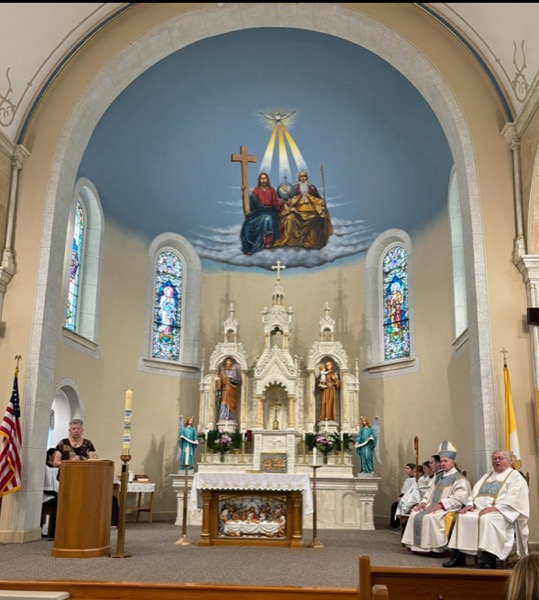
Fourteen years passed and a few days after Christmas in 1917, on a very cold, snowy Saturday afternoon, a fire started, destroying the church. No one was killed or seriously injured, yet the parishioners were somber as the new year started. It was also at the time when the United States was involved in World War I.
Thanks to monetary donations, donated labor and material, a loan, and the leadership of a Franciscan Brother named Christopher, the building was rebuilt. On Dec. 8, 1918, the Feast of the Immaculate Conception, the church was dedicated and once again was home to the people of St. Joseph. The church was updated over the years, and then damaged again — this time by a tornado in 1945 — with proper repairs made after WWII.
In 1922, a new era began at the parish, when Bishop James Ryan appointed Father George Nell, a 35-year-old diocesan priest, as first resident pastor of St. Joseph Parish. Father Nell served the parish for an amazing 39 years, helping out farmers who were having difficulties, standing by his people during the Great Depression and several wars, and generally taking the best care that he could of his family of parishioners.
Father Nell helped organize the Jasper County Farm Bureau and organized a Campaign for Christ in Jasper County. He was famous and appreciated for putting in extremely long days for the benefit of not only his parishioners, but his community as well. Toward the end of his life, he was given an honor bestowed on “truly outstanding benefactors” of the Franciscan Order of Friars Minor and received the Franciscan habit and official document of affiliation from the Minister General of the Franciscan Order. This honor recognized his work in the fields of religious education and in appreciation with his cooperation in his area with the Third Order of St. Francis, of which he was a member for 60 years.
On Oct. 14, 1961, the beloved Father Nell passed away, leaving his parishioners to grieve his loss. As was his wish, he was laid to rest in the cemetery at St. Joseph, where the people erected a large memorial cross in his honor. Further enhancements to his final resting place were added at a later date.
Less than a year following Father Nell’s death and after a brief time with a priest administrator, Father Carl Schmidt became the second resident diocesan priest at St. Joseph. He immediately involved himself not only with the parishioners, but with updating the church as well. At one point, he and his brother, Father Anthony Schmidt, painted the sanctuary ceiling. When the Vietnam War was happening, Father Schmidt led his parishioners through those difficult times. Father Schmidt faithfully led the parishioners at St. Joseph for 26 years.
Beginning in 1988, St. Joseph Parish came back into the care of the Franciscans, revisiting the Franciscan heritage of the parish’s first 50 years. Several Franciscan leaders have come and gone over the past 35-plus years. Today, Father Juan Carlos Ruiz, OFM, is the new pastor. Mass is celebrated at St. Joseph on Sunday mornings at 10 a.m. and Thursday mornings at 8 a.m.
In April, Bishop Thomas John Paprocki visited St. Joseph Church for a Mass of Thanksgiving. From Friday evening Sept. 6 through Sunday morning, Sept. 8, the people of St. Joseph will be holding a celebration of the parish’s 150 years with a variety of fun events, including games and music open to the public Friday evening, and Saturday afternoon and evening. A time capsule — to replace the 1999 time capsule that will be removed on Sept. 6 — will be buried following the Sunday morning Mass. All these activities were planned by members of the Sesquicentennial Committee for St. Joseph.
Sandy Meinhart, the co-chair of that committee, is married to John Paul Meinhart, a descendant of Mathias Meinhart. “Just off the top of my head I will say that we currently have children who would mark the sixth generation after the original immigrant/settler in the Meinhart family,” she said. “Father Michael Meinhart (pastor of St. Louis Parish in Nokomis, who was ordained in 2020) is the son of my husband’s first cousin. Father Michael represents the fifth generation after the original immigrant who was born in Autergua County, Kreis Wells, Austria.
“You know, I get really excited when sharing information about our physical church, our faith community, and the heritage — both spiritually and physically — we were given by the first settlers in the area,” said Meinhart, who is looking forward to the upcoming church celebration.
Note: Thanks to Sandy Meinhart, who provided much of the historical material for this article.