
Perpetual Pilgrims speak out about National Eucharistic Pilgrimage
By DIANE SCHLINDWEIN
Managing Editor
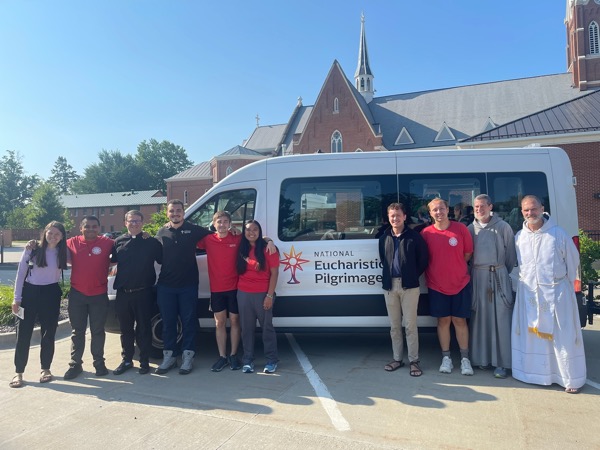
Although thousands of people participated in the National Eucharistic Pilgrimages across the United States, each of the four routes were accompanied by young people known as perpetual pilgrims, who walked in faith from Pentecost Sunday (May 19) until they reached Indianapolis for the National Eucharistic Congress.
Perpetual pilgrims on the Western route which traveled through the Diocese of Springfield in Illinois (known as St. Junipero Serra Route) were: Chima Adiole, Jaella Mac Au, seminarian Dereck Delgado, Patrick Fayad, Chas Firestone East, Jack Krebs, Madison Michel, and seminarian Jimmy Velasco. Two chaplains accompanied the group, but the chaplains switched out along the way, said Fayad during an interview on July 10.
The Serra Route was the longest of the four National Eucharistic Pilgrimage routes, launched in San Francisco and crossing California, Nevada, Oregon, Idaho, Utah, Colorado, Nebraska, Iowa, Kansas, Missouri, and Illinois before reaching Indianapolis.
The Serra route pilgrims estimated they walked through more than 75 towns and cities of all sizes. “We were in San Francisco and Denver, for example, but we also went to small towns,” said Fayad. “We went to Stoneham, Colo., which has a population of just 15.” Sometimes they were traveling in temperatures that reached 100 degrees.
“We were very well received by the public. They were very welcoming, ” said Firestone. “We only came upon two protestors along the way. Non-Catholics tend to be curious about what we were doing.”
“It was very powerful seeing the devotion of the lay faithful,” said Fayad. “Their faith reminds me what I am doing when it becomes easy to forget. I was impressed by excitement with which people await the Eucharist.”
Firestone said the pilgrims have noticed as they have traveled that Catholics from different areas have “a variety of devotional styles.” He said he has adapted some of those styles and found that by acting as a crucifer — carrying the cross in procession — he has “developed a special devotion to the crucifix.”
Mac Au said she views the pilgrimage as a transformative experience. “It’s about the journey, not the destination,” she said. “That’s really what it is all about.” She said because Jesus desires to seek out our humanity, walking with the Eucharist is a tangible reminder that the Lord desires to love us in a very humane and human-like way.
Velasco added he particularly liked to see young families as they traveled around. “You hear babies, which is a very beautiful sign to see in church. You know the Church is alive when you hear babies crying.”
The pilgrims not only walked with Jesus, but they did service in His name. “Saturdays were our service days,” said Fayad. On those days, the young people completed a service project that was chosen by the people they were working with. “We did different things. We worked with Christ in the City in Denver, we built benches for a church — just a number of things,” he said.
For example, the weekend before they made their way to the Springfield diocese, the pilgrims visited the Missionaries of Charity at their St. Louis home. There they helped carry “blessing boxes” containing donations to an apartment complex where a large number of Latin American and African refugees live. “The sisters took our service very seriously,” Fayad said. “It was a huge gift.”
For two months they were walking in procession, of course, and rode in a vehicle between cities. They had only one full day off: Independence Day. However, as they traveled along the way the pilgrims never really knew in advance what to expect as far as accommodations went. All those plans were made by the people and parishes in the areas they traveled.
“We knew what direction we were going: East,” said Fayad. “We didn’t know where we would sleep or eat.” They stayed at parishes, shrines, retreat centers, and with lay people. Along the way they met and worshiped with Dominicans, Franciscans, Benedictines, Carmelites, and, on July 10 in Springfield, the Norbertines.
When they finally reached the National Eucharistic Congress, the young pilgrims continued to volunteer as they were needed. They will leave for their homes on July 21. Firestone said for the last two months, the pilgrims have been “living in obedience” and it seems the experience has been one in which all the pilgrims have grown in spirit.
Fayad had a special way to sum up what he and other young pilgrims have been doing. “We have been the mules on whose back the Lord rode to Jerusalem — or in this case Indianapolis.”